Phone orders still drive 60 to 70% of regional food distribution volume because buyers trust the relationship, not because the channel is efficient. The cost hides in manual entry: every order takes a clerk minutes to key in, and manual processing runs $50 to $150 per order (APQC, 2023). The fix keeps the call and removes the typing.
Why Do Food Distribution Buyers Still Call Instead of Ordering Online?
Buyers still call because the relationship drives the order, not the channel. A chef or kitchen manager trusts a rep who knows their menu, their substitutions, and their delivery window. For a complex order with last-minute changes, talking is faster for the buyer than any portal. The habit is not going away in 2026.
This is the part most automation pitches get wrong. They assume the goal is to move buyers off the phone. In food distribution, 60 to 70% of order volume arrives by phone or fax, and a large share comes from accounts that place modified, time-sensitive orders. The phone call is a feature for the customer. The problem is what happens after they hang up.
What Does a Single Phone Order Cost Once Your Team Keys It In?
The cost lands in manual order entry, the manual keying of a phone or fax order into your order system by a clerk. A clerk spends 3 to 5 minutes per order, and manual processing of one order runs $50 to $150, with complex orders reaching far higher (APQC, 2023). Volume turns minutes into a major operating cost.
Most distributors we analyze spend $30 to $100 per manual order entry in direct labor alone, before a single correction. Independent benchmarks put fully loaded manual order entry at $8 to $15 per order at the low end (Mirage Metrics, 2024). The right way to read this is cost per order, or cost-to-serve: the full cost to process one order, not just the wage of the person typing it.
That number also caps your order desk capacity, the number of orders one clerk can handle in a shift. When volume spikes, the only manual lever is more headcount. Cost per order and order desk capacity move together, and both get worse as you grow.
| Order handling | Time per order | Cost per order | Capacity per clerk |
|---|---|---|---|
| Manual order entry | 3 to 5 min | $50 to $150 (APQC) | Fixed, scales with headcount |
| Capture with validation | Under 1 min review | Lower per order | Higher, same headcount |
Where Do Manual Order Errors Hit Your Margin and Your Customers?
Errors are the second cost, and they hit harder than labor. Order accuracy, the share of orders shipped with zero errors (also called perfect order rate), drops under manual entry. 33% of B2B orders contained errors over the past year (Sapio Research, 2025). In food distribution, a wrong SKU or quantity is a missed delivery, a credit, and a phone call you did not want.
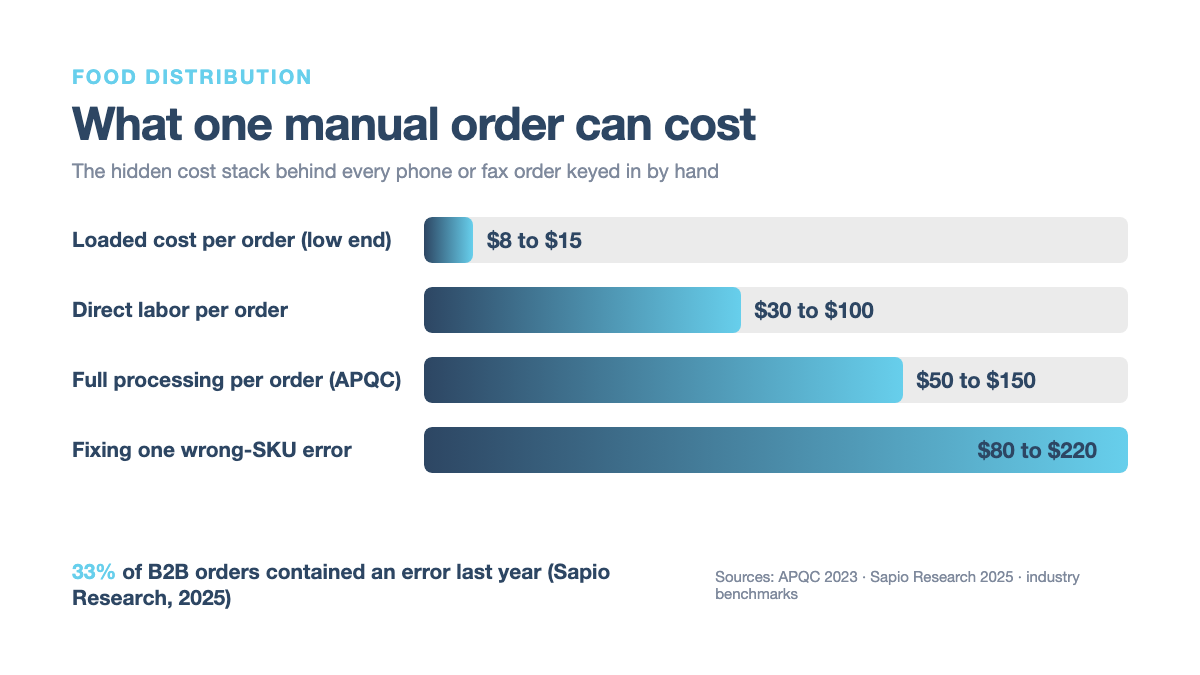
Manual order lines carry a 3 to 8% error rate, and a single wrong SKU costs $80 to $220 to correct once you count returns, redelivery, and admin (industry benchmarks, 2024). The bigger cost is trust. Each error raises customer churn, the loss of an account after repeated order problems. Order accuracy is not a back-office metric. It is a retention metric, and the kitchen remembers the last mistake longer than the last on-time delivery.
How Do You Keep the Phone Call and Remove the Manual Entry?
You separate the conversation from the keying. Voice-to-order capture, technology that turns a spoken or recorded phone order into a structured order line automatically, keeps the call and removes the typing. The buyer still talks to your rep. The system drafts the order, checks stock and pricing, and flags only the exceptions for a human to confirm.
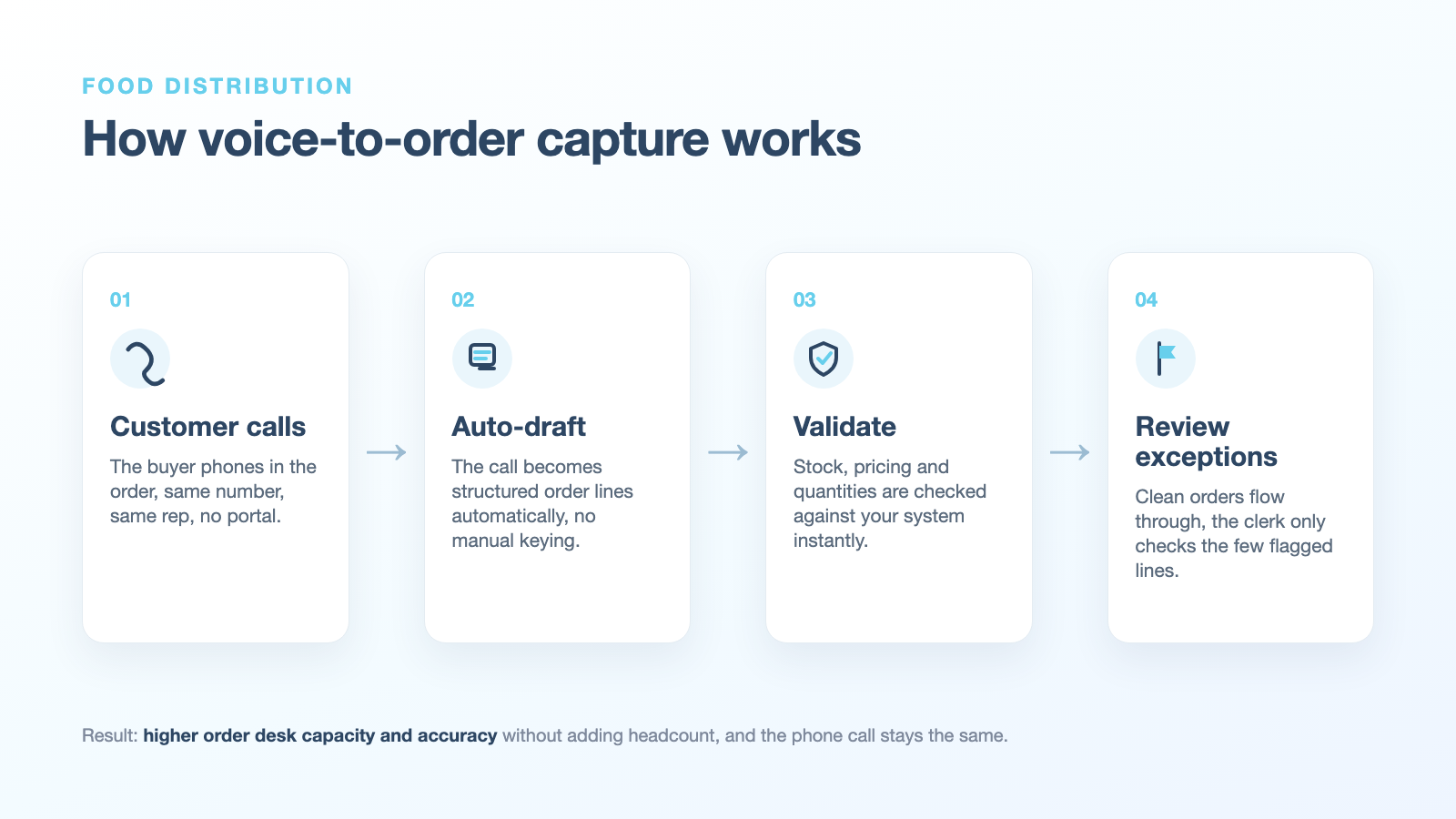
In practice, capture works in a few steps:
- Capture the order from the call or voicemail and draft it as order lines automatically.
- Auto-fill recurring items from the account's order history, since most accounts reorder the same core list.
- Validate stock, pricing, and quantities against your system, then flag only the exceptions.
- Route the clean order straight through, and send only the flagged lines to a clerk to review.
This is the difference between a clerk who types every order and a clerk who reviews exceptions. Voice-to-order capture raises order desk capacity without new hires and lifts order accuracy at the same time. For distributors stuck on order desks built around a legacy system, this is the kind of work covered by a focused legacy workflow modernization sprint, which removes the manual step without ripping out the ERP underneath it.
Is It Risky to Automate Order Capture Without Forcing Customers Onto a Portal?
No, and that is the point. The phone number stays the same and the customer notices nothing. Capture sits on top of your existing order process and your existing system. It reads and drafts orders rather than replacing your ERP, so there is no migration and no disruption to daily operations. Your team keeps control by reviewing exceptions.
The human question matters too. Removing manual order entry does not remove the order desk clerk. It moves them off repetitive keying and onto the work that needs judgment: catching unusual orders, handling exceptions, and keeping accounts happy. That is also how you treat order flow as part of a connected supply chain, not as an isolated typing task. The call stays human. The data entry does not have to be.
What Is the Typical Error Rate on Manually Entered Orders?
Manual order lines carry a 3 to 8% error rate, and 33% of B2B orders contained at least one error over the past year (Sapio Research, 2025). A single wrong SKU costs $80 to $220 to correct once returns, redelivery, and admin time are counted, and repeated errors are a leading cause of lost accounts in food distribution.
How Many More Orders Can One Order Desk Handle After Automating Capture?
The gain comes from shifting clerks from keying every order to reviewing only flagged exceptions. Since most accounts reorder a stable core list, auto-fill and validation remove most of the manual time. That raises capacity without new headcount and reduces overtime during demand spikes, so the same team absorbs growth instead of falling behind it.
How Long Does It Take to Add Order Capture to an Existing System?
Adding a capture layer is a focused project, not a system replacement. Because it reads from and writes to the ERP you already run, there is no migration. A scoped engagement typically runs 4 to 8 weeks, starting with your highest-volume accounts, so you see the cost and accuracy change on real orders before rolling it wider.
The Bottom Line for Your Order Desk
Phone orders are not the problem. Manual entry behind them is. Start by measuring what one manual order actually costs you, then test capture on your highest-volume accounts. 3ALICA builds this layer on top of your current system in a 4 to 8 week sprint, so the call stays the same and the manual keying goes away.
Taking one manual order path off the phone without touching the ERP behind it is the Workflow Automation Sprint.