In most SMB distributors, the right prices, discounts, tier logic, and customer-specific deals live in one or two people's heads and spreadsheets. When they retire, that knowledge leaves with them. Because a 1% shift in price moves operating profit about 8% (McKinsey), even small pricing drift gets expensive. The fix is to codify the rules before the expert goes, not after.
Where a distributor's pricing knowledge actually lives
In a lot of distribution businesses, pricing is not in a system. It is in one person. That person knows which customers get which discount, how tier pricing (prices that step down as a customer buys more volume) works, which accounts have customer-specific pricing (negotiated prices that differ from the list), and when seasonal adjustments apply. Most of it is undocumented, or it lives in a spreadsheet only they fully understand. That is key-person risk (the business depending on one person whose knowledge is not written down), and in pricing it is common and quiet.
Why losing that knowledge is expensive
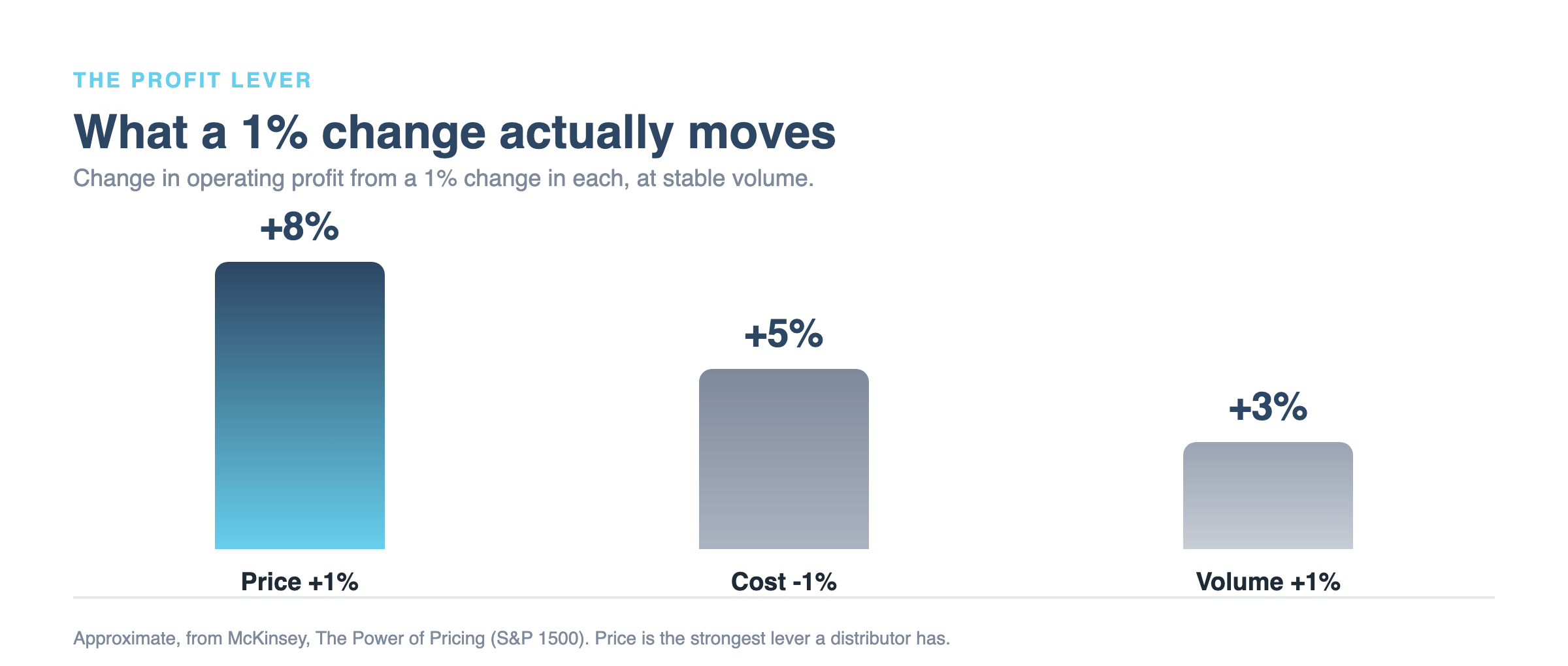
Pricing is the most sensitive lever a distributor has. McKinsey found that a 1% change in price moves operating profit by about 8%, a bigger effect than a 1% change in cost or volume (McKinsey, The Power of Pricing). So when the person who holds the pricing leaves, the risk is not just inconvenience, it is margin. A replacement takes 6 to 12 months to learn the accounts, and in that window prices drift. On a $20M distributor, even a 2% margin drift is $400,000 of profit. The timing is not hypothetical: more than half of US small-business owners are over 55, and wholesale distribution has the highest concentration of owners past 65 (McKinsey, 2026).
The blind spot is margin nobody can see
The deeper problem is that most distributors cannot see margin visibility (profit by individual customer and product, not just company-wide). Pricing is a matrix of customers by products, and without a view into it, margin leakage (products quietly sold below their proper margin) goes unnoticed. In our work with distributors, it is common to find that a tenth or more of SKUs are underpriced, losing money on every order, with no one aware. When the expert who "just knew" which prices were right is gone, that blind spot gets wider.
Codifying pricing expertise is not an AI model
Capturing what the expert knows does not require artificial intelligence. It requires a pricing rules engine (a system that encodes the expert's pricing logic as explicit rules: the discount tiers, the customer exceptions, the floors and the seasonal moves). The knowledge in one person's head becomes rules the whole team can see and apply.
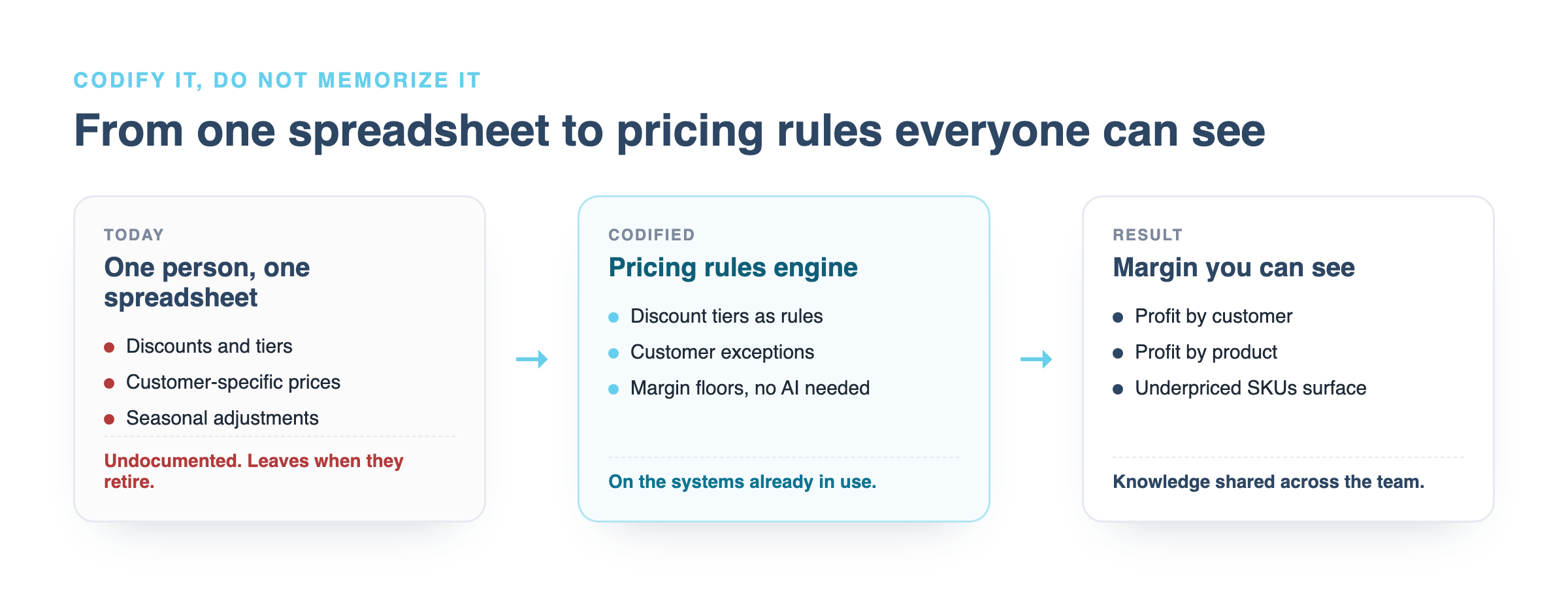
In our pricing work with distributors, the starting point is almost always the same: the real pricing lives in one spreadsheet, so the first step is to get it out of that spreadsheet and into rules, described in our inventory and pricing case. The engine runs on the systems a company already has, so nothing is ripped out.
Pricing accuracy and the rebate connection
Pricing and supplier rebates are linked. Rebate tiers (supplier incentives earned by hitting volume or purchase thresholds) depend on buying and selling at the right levels. When pricing drifts, so does the volume mix that qualifies for rebates, and margin leaks from two directions at once. Getting the pricing rules right protects the rebate dollars a distributor has already earned, on top of the margin on each sale.
Frequently asked questions
Why is pricing knowledge such a key-person risk in distribution?
Because in most SMB distributors the discount logic, tier pricing, and customer-specific deals are never written down. They live in one or two people's heads and spreadsheets. If that person retires or leaves, the business loses the reasoning behind its prices, and there is no system to fall back on. It is one of the most common and least discussed single points of failure in distribution.
What does it cost when a pricing expert leaves?
The main cost is margin drift while a replacement learns the accounts, which usually takes 6 to 12 months. Since a 1% price change moves operating profit about 8% (McKinsey), even a small drift is expensive. On a $20M distributor, a 2% margin slip is roughly $400,000. The cost is rarely visible as a single event, which is what makes it dangerous.
What is a pricing rules engine, and is it an AI model?
It is a system that encodes an expert's pricing logic as explicit rules: discount tiers, customer exceptions, margin floors, and seasonal adjustments. It is not artificial intelligence. It is the expert's knowledge, written down and applied consistently by the system instead of held in one person's memory, so the whole team can see and use it.
How do distributors lose margin on underpriced SKUs?
Pricing is a large matrix of customers by products, and without margin visibility per line, some products end up priced below their proper margin. Those items sell at a loss on every order while total revenue still looks fine. In our experience, a tenth or more of SKUs can sit underpriced, unnoticed, until someone looks at margin product by product rather than in aggregate.
How does pricing accuracy affect supplier rebates?
Supplier rebate tiers depend on hitting volume and purchase thresholds. When pricing drifts, the volume mix that qualifies for those rebates drifts too, and earned rebate dollars are left on the table. Accurate, consistent pricing keeps both the margin on each sale and the rebate tiers intact, so the business does not leak money from two directions.
Do it before the expert leaves, not after
The cheapest time to capture a pricing expert's knowledge is while they are still in the building. Codifying the rules into a system spreads the knowledge across the team and makes margin visible by customer and product. If one or two people hold the pricing for a distribution business, mapping and codifying that knowledge is worth doing before they leave. 3ALICA builds those pricing rules and margin views on the systems a company already runs.
Sources
- McKinsey, The Power of Pricing: a 1% price change moves operating profit by about 8%
- McKinsey, The Great Ownership Transfer: over half of US small-business owners are 55 or older, with wholesale distribution among the oldest
Putting that judgement into a system before it walks out the door is the Inventory Optimization Sprint.