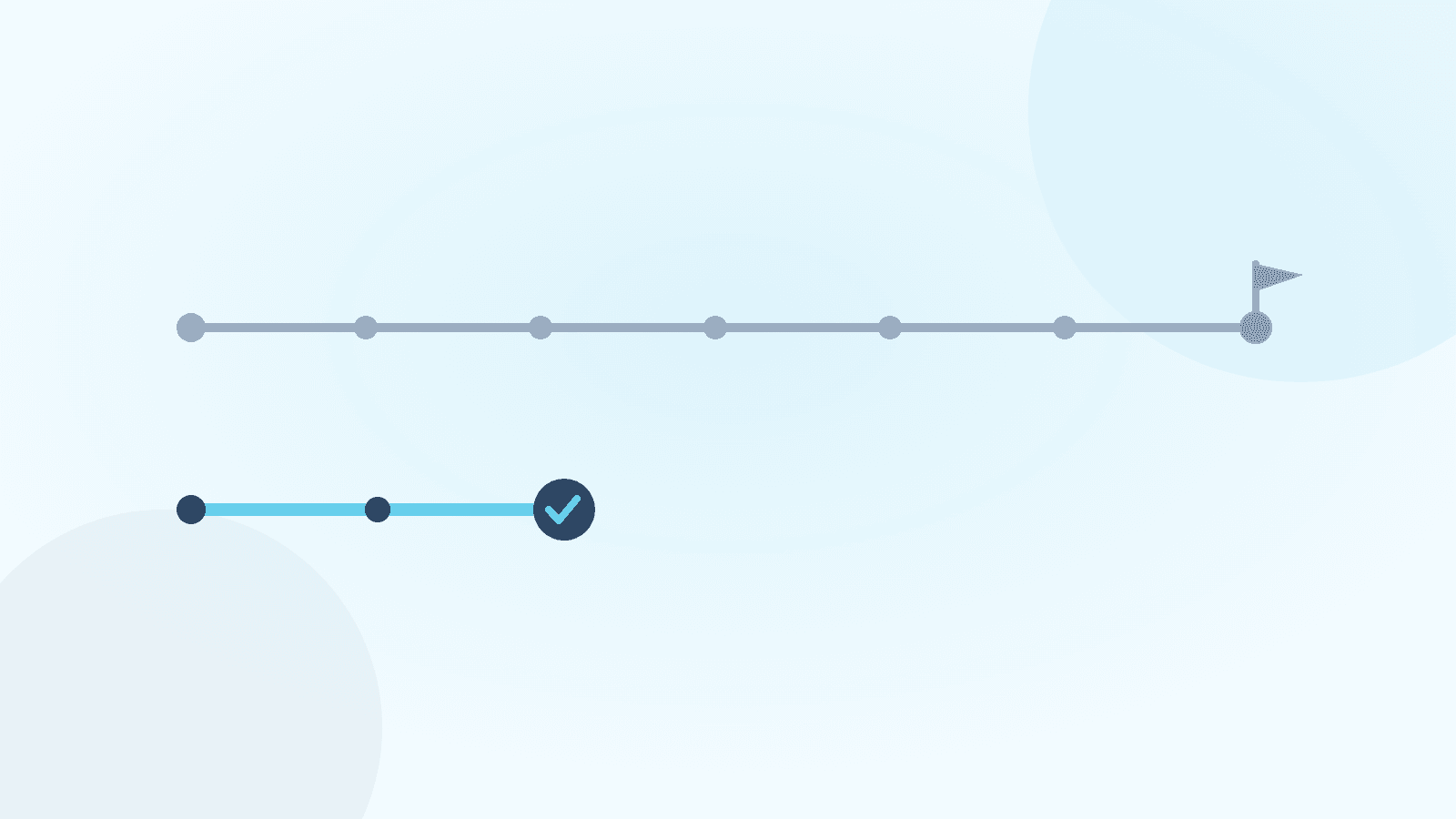
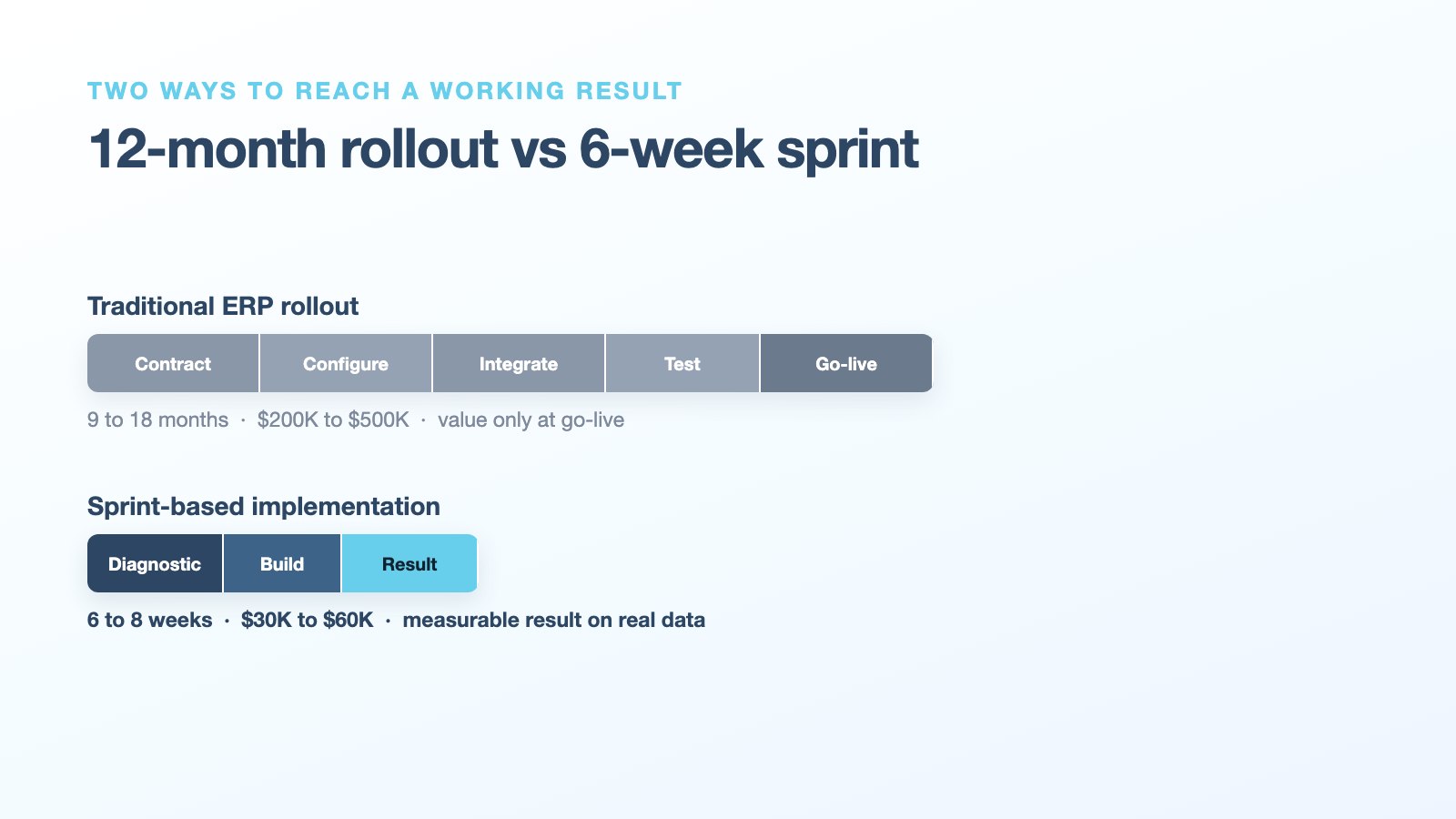
Traditional software implementations lock SMBs into 9 to 18 month cycles and $200K contracts before proving whether the solution fits their actual operations. A sprint-based model runs a diagnostic on real client data, builds one module, and delivers a measurable result in 6 to 8 weeks. 50% of ERP projects fail on first attempt. Testing before committing is not cautious, it is the only rational approach.
What Does a Traditional Operations Software Project Actually Cost a Mid-Market Business?
The average ERP implementation costs $450,000 for a mid-sized organization, according to Panorama Consulting Group's 2025 ERP Report. That number does not include the operational disruption at go-live, which 51% of companies experience, or the productivity loss during a 9 to 18 month implementation cycle where requirements shift faster than the project can adapt. (Panorama Consulting / RubinBrown, 2024 to 2025)
The structure of a traditional software project creates the problem before the first meeting ends. The sequence goes: RFP, vendor selection, contract signing, requirements documentation, system configuration, integration work, testing, training, go-live. Each phase adds time. Each handoff adds risk. By the time a distribution company or manufacturer reaches go-live, the business has often changed enough that the original requirements no longer reflect current operations.
ERP implementation risk (the documented probability that a software deployment will exceed its budget, miss its timeline, or fail to deliver expected operational benefits) is not a fringe concern. 50% of ERP implementations fail on their first attempt, and most exceed initial budgets by 3 to 4 times. (Panorama Consulting Group, 2024 to 2025) Those are not outlier numbers. They are the median experience.
The financial exposure is compounded by scope creep (the expansion of project requirements beyond the original definition during implementation), which Panorama Consulting identifies as the cause of overruns in 35% of ERP failures. Scope creep is not a planning failure. It is the predictable result of locking requirements into a contract and then running 12 months of business before the system goes live.
Why Does the Traditional Implementation Model Survive Despite a 50% Failure Rate?
The traditional model survives because it concentrates risk on the buyer. Vendors collect payment across milestones regardless of whether the system delivers value. The buyer assumes the implementation risk, the integration risk, the change management risk, and the sunk-cost pressure to push forward even when early signals suggest the project is off-track.
ERP implementation risk is typically mispriced at the point of contract. A $250,000 proposal looks like a bounded investment. It rarely is. Budget overruns typically stem from underestimated staffing (38%), scope expansion (35%), and technical or data issues (34%), according to Panorama Consulting's 2025 ERP Report. The final cost regularly reaches $450,000 or more before accounting for internal team time, productivity loss, or post-launch remediation.
The time to value (TTV, the elapsed time between project kickoff and the delivery of a first measurable business result) in a traditional implementation is deferred by design. Value only becomes visible at go-live, which arrives 9 to 18 months after contract signing. By that point, the organization has spent capital, absorbed disruption, and has no practical off-ramp.
What Is Sprint-Based Implementation and How Does It Change the Risk Structure?
Sprint-based implementation is a time-boxed delivery model that builds and validates one functional module in 6 to 8 weeks using the client's actual data, producing a measurable result before any full-scale commitment. The client sees a working output on their own data before signing anything beyond the initial sprint agreement.
The model works by compressing the distance between investment and evidence. Instead of asking a business to commit to a full system and wait 12 months for proof, sprint-based implementation asks: what is the one operational problem worth solving in the next 6 weeks? That constraint forces specificity, which is what most traditional projects lack.
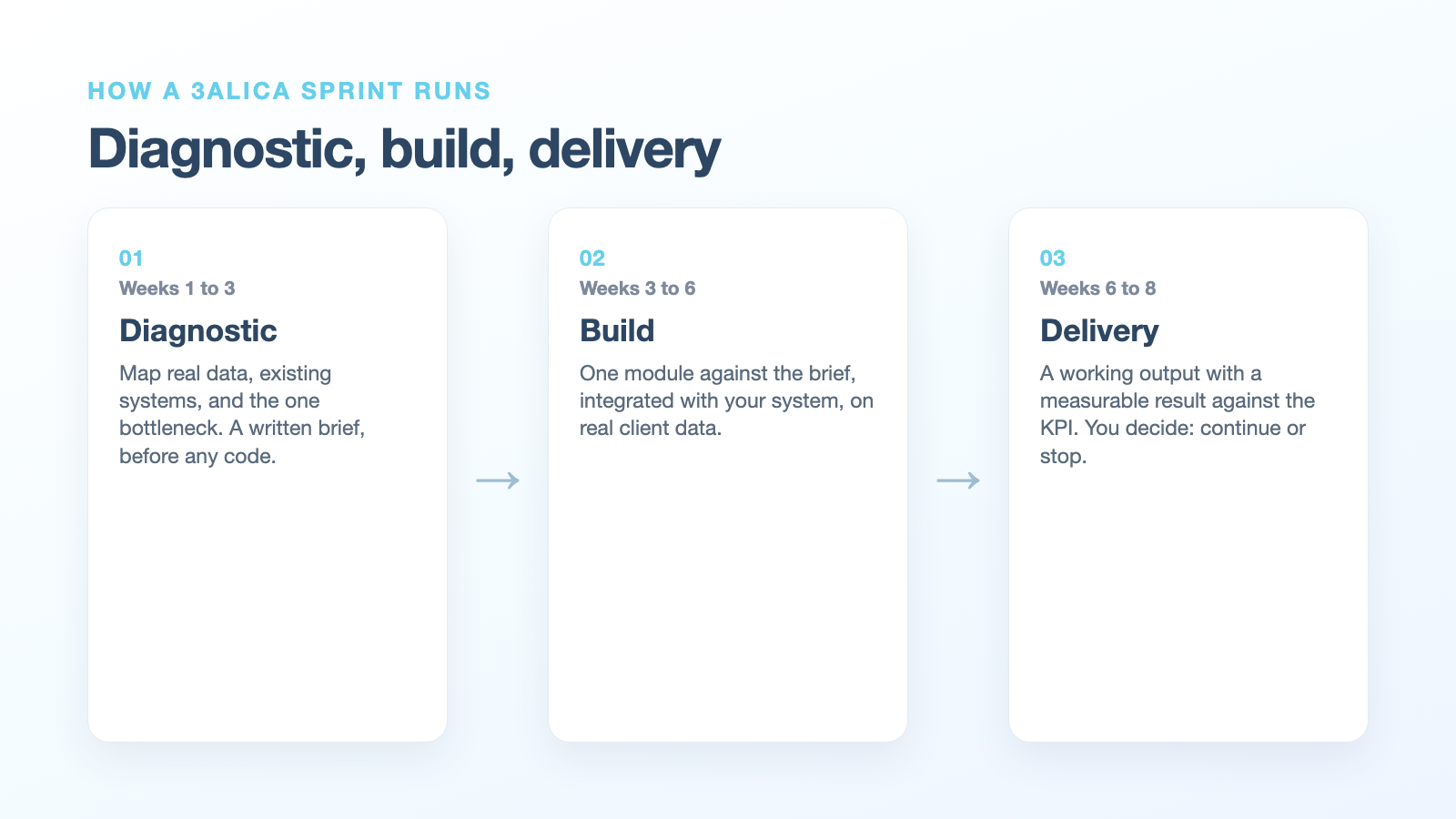
The sprint structure at 3ALICA follows three phases:
- Diagnostic Phase (weeks 1 to 3): Map the client's actual data, existing ERP or CRM systems, and the specific operational bottleneck. No code is written until the diagnostic is complete. This is the step that traditional RFP-driven projects skip. The diagnostic phase produces a written brief: what the problem actually is, what data exists to address it, what a working module would look like, and what a measurable result looks like.
- Build Phase (weeks 3 to 6): Build one module against the diagnostic brief. Integrate with the existing system. Use real client data, not demo data or sandbox environments.
- Delivery (week 6 to 8): Present a working output with a measurable result against the KPI defined in the diagnostic. The client decides whether to continue to a second sprint or stop.
The total investment for a single sprint runs $30,000 to $60,000 depending on scope, compared to the $150,000 to $450,000 typically required before traditional implementations produce any verifiable output. See how 3ALICA structures these sprints for established SMBs at 3alica.com/smb.
How Does a Proof of Concept Differ From a Sprint, and Which One Do You Actually Need?
A proof of concept (POC) is a scoped technical test that validates whether a proposed solution can solve a specific operational problem, distinct from a full implementation in that it is deliberately constrained in cost, time, and risk. A sprint-based implementation goes one step further: it does not just test whether a solution is technically feasible, it delivers a production-ready working module.
The distinction matters for buyers. A proof of concept answers the question: can this technology solve this problem? A sprint answers: does this specific build, on our specific data, produce a measurable improvement? The second question is the one that actually protects capital.
| Delivery Model | Timeline | Cost Range | Output | Decision Point |
|---|---|---|---|---|
| Traditional ERP rollout | 9 to 18 months | $200K to $500K+ | Full system at go-live | Committed at contract signing |
| Proof of Concept (POC) | 2 to 4 weeks | $10K to $30K | Technical feasibility confirmation | After POC results |
| Sprint-Based Implementation | 6 to 8 weeks | $30K to $60K | One working production module | After sprint delivery |
| Sprint Expansion (3 sprints) | 18 to 24 weeks | $90K to $180K | Multi-module operational system | After each sprint |
The sprint model restructures when the decision point arrives. In a traditional rollout, the decision happens at contract signing. In sprint-based delivery, the decision happens after measurable evidence. A business that runs a single sprint and decides not to continue has spent 6 weeks and $30,000 to $60,000, not 12 months and $450,000.
Time to value is what the sprint model is fundamentally about. In a traditional implementation, TTV can reach 18 months. In a sprint, the first measurable result arrives in 6 to 8 weeks. The operational team can evaluate it. The COO can evaluate it. The decision to expand or stop is made with data, not with hope.
What Does the Diagnostic Phase Reveal That a Vendor Demo Never Shows?
The diagnostic phase (the structured 2 to 3 week upfront stage in which a consultant maps the client's real data, existing systems, and bottlenecks before writing a single line of code) surfaces the information that a vendor demo is specifically designed to obscure.
A vendor demo runs on clean, curated data in a controlled environment. It shows the system performing correctly under optimal conditions. The diagnostic phase runs on the client's actual data, which is typically fragmented across an ERP, several spreadsheets, a warehouse management system, and a collection of manual workarounds. The gap between demo and reality is where 35% of ERP projects encounter scope creep significant enough to cause budget overruns. (Panorama Consulting, 2025)
The diagnostic phase produces three outputs that do not exist in a traditional pre-sales process:
- A data audit: what data actually exists, in what format, in what systems, and how complete it is
- A bottleneck map: which specific process is generating the most operational friction or financial loss
- A sprint brief: what one module would address the bottleneck, what integration is required, and what a measurable result looks like in 6 weeks
These outputs are valuable regardless of whether the client continues to a build sprint. A business that completes a diagnostic and decides not to proceed still has a clearer picture of its operational data infrastructure than it had before.
How Does a Sprint Model Expand Into a Full Operational System Without Creating a New Version of the Same Risk?
The expansion model follows a sequential sprint structure: each sprint delivers one measurable result, and each result becomes the foundation for the next sprint. Sprint-based implementation does not require committing to the full system in advance.
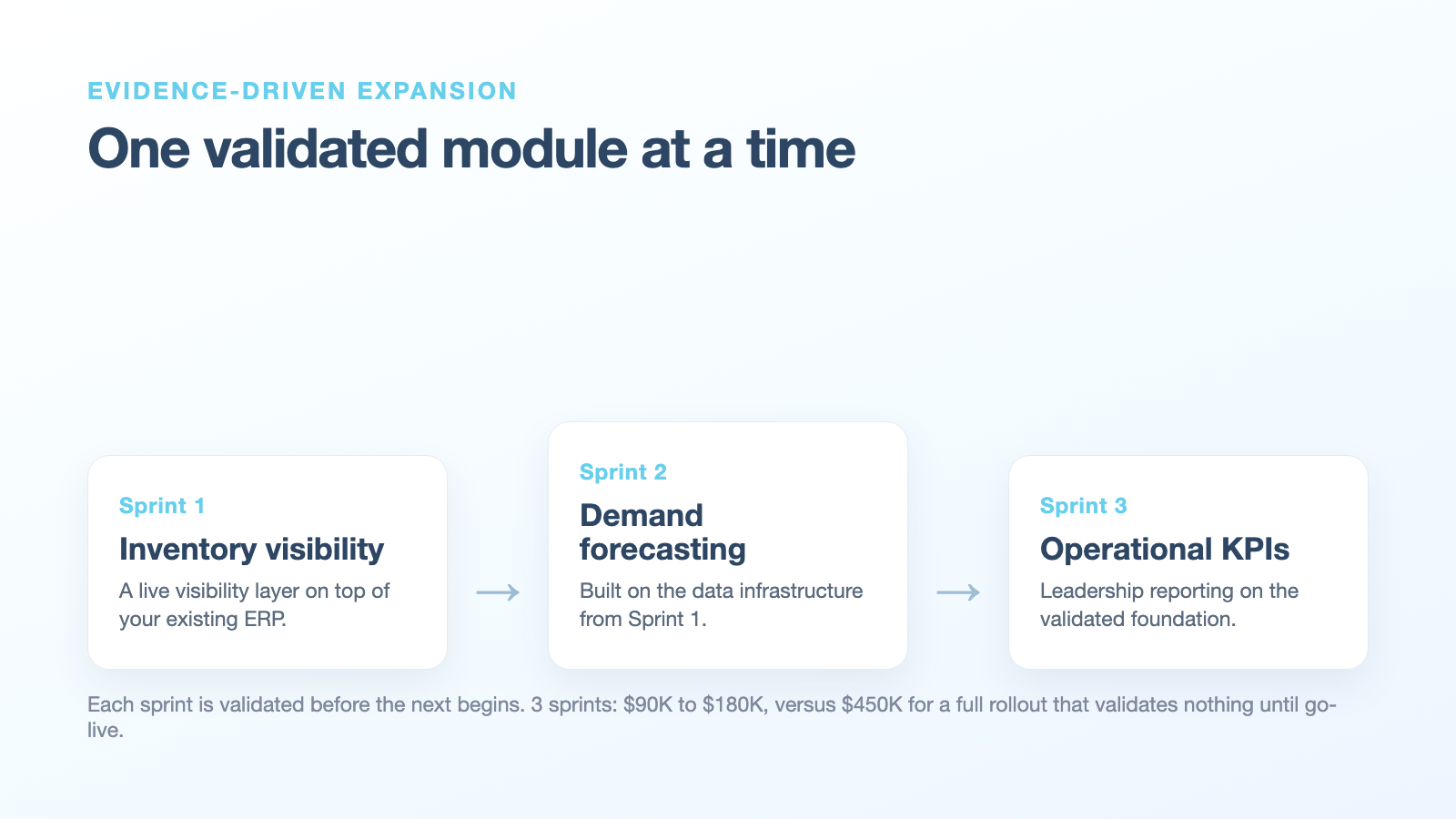
Sprint 1 might deliver a working inventory visibility layer integrated with the existing ERP. Sprint 2 might add a demand forecasting module using the data infrastructure built in Sprint 1. Sprint 3 might add operational KPI reporting for the leadership team. After three sprints, the business has a multi-module system built on its actual data, with each component validated before the next one is started. For a real example of what a single sprint delivers on operational forecasting data, see the predictive sales forecasting case study.
The total cost of three sprints runs $90,000 to $180,000, compared to the $450,000 average for a traditional mid-market ERP implementation that delivers everything at once and validates nothing until go-live. The ERP implementation risk profile of the sprint model is structurally different: no single sprint failure is catastrophic, because no single sprint carries the full system commitment.
Scope creep is controlled by design. Each sprint has a fixed scope, a fixed timeline, and a defined measurable result. Changes to scope start a new sprint, they do not extend the current one. This is the opposite of how traditional projects manage scope creep: by absorbing requests into the existing contract until the timeline collapses.
Frequently Asked Questions About Sprint-Based Software Implementation
What is the difference between a sprint-based implementation and a traditional ERP rollout?
A traditional ERP rollout requires signing a full contract before any build work begins, typically $150,000 to $450,000, with go-live 9 to 18 months later. Sprint-based implementation starts with a 6 to 8 week fixed-scope build on one specific operational problem using the client's real data. The decision to continue or stop comes after seeing a working result, not before.
What does a 6-week diagnostic and build sprint actually deliver at the end?
A sprint delivers one production-ready module integrated with the client's existing ERP or operational systems, built on the client's actual data, and measured against a specific KPI defined in the diagnostic phase. Examples include an inventory visibility layer, a demand forecasting module, or an operational KPI dashboard. The deliverable is working software with a measurable result, not a prototype or a demo.
How do you decide which operational problem to solve in the first sprint?
The diagnostic phase makes this decision explicit. During weeks 1 to 3, the consultant maps the client's data infrastructure, operational processes, and pain points. The sprint brief that comes out of the diagnostic identifies the single bottleneck generating the most financial or operational impact that can be addressed within the 6-week build window. The client approves the brief before build work begins.
What happens to the work done in a sprint if the company decides not to continue?
All code, integrations, and documentation produced during the sprint belong to the client. The sprint is a fixed-price, fixed-scope engagement with no ongoing contractual obligation beyond the sprint itself. A company that completes a sprint and decides not to continue has a working production module and full ownership of everything built. There is no vendor lock-in at the sprint level.
How does a sprint model expand into a full operational system over time?
Each sprint delivers one validated module. The next sprint builds on the data infrastructure and integrations created in the previous one. After three sprints, a business typically has a multi-module system covering the highest-priority operational bottlenecks. The expansion is sequential and evidence-driven: no sprint begins until the previous one delivers a confirmed result. The cumulative cost of three sprints is $90,000 to $180,000 versus $450,000 for a traditional full-system implementation.
The Bottom Line: Test Before You Commit to 12 Months
If your business is evaluating a software proposal in the $150K to $300K range, the question worth asking first is: can we validate this on our actual data before we sign? 3ALICA runs a diagnostic and build sprint in 6 to 8 weeks, with a measurable result at the end and no obligation to continue. The risk of testing is 6 weeks. The risk of not testing is 12 months.
Sources
- Panorama Consulting Group / RubinBrown ERP Advisory (2024 to 2025): ERP failure rates, timeline overruns, operational disruption. https://kpcteam.com/kpposts/top-erp-statistics-trends
- Panorama Consulting Group 2025 ERP Report: $450,000 average implementation cost, budget overrun causes (staffing 38%, scope 35%, technical 34%). https://www.dualentry.com/erp-implementation-cost-calculator (primary report gated; manual fallback search: Panorama Consulting 2025 ERP report $450,000 average implementation cost mid-market)
Every one of our operations sprints is built this way: one workflow, one measurable result, a fixed scope agreed before the work starts.