
Your best operations people do not hate software for no reason. They hate covering its gaps with private spreadsheets that live only on their laptop. That creates key-person dependency: when they leave, operations stall for months. Replacing them costs 50 to 200% of their salary (SHRM and Gallup). Automating the routine they do by hand fixes both problems.
Why Do Your Experienced Operations Staff Build Their Own Spreadsheets?
Because the system does most of the job, but not the last part they need. When the ERP does about 90% of the work, your best people bridge the final 10% with their own files. Around 60% of businesses still run core processes on Excel, and 70% of companies have shadow IT, tools adopted without IT oversight (Vanta, 2026).
These are not rule-breakers. They are your most capable operators solving a real gap the software left open. Shadow spreadsheets, the private Excel files and workarounds that live outside the main system, are how a warehouse manager or order desk lead keeps the operation moving. The work gets done. The risk just moves out of sight.
What Is Key-Person Dependency, and Why Is It a Business Risk?
Key-person dependency is when the business relies on the knowledge of one or two people to keep running. The expert knows the system better than IT, has built 15 spreadsheets that quietly hold operations together, and is the only one who understands them. The files exist on one laptop. The logic exists in one head.
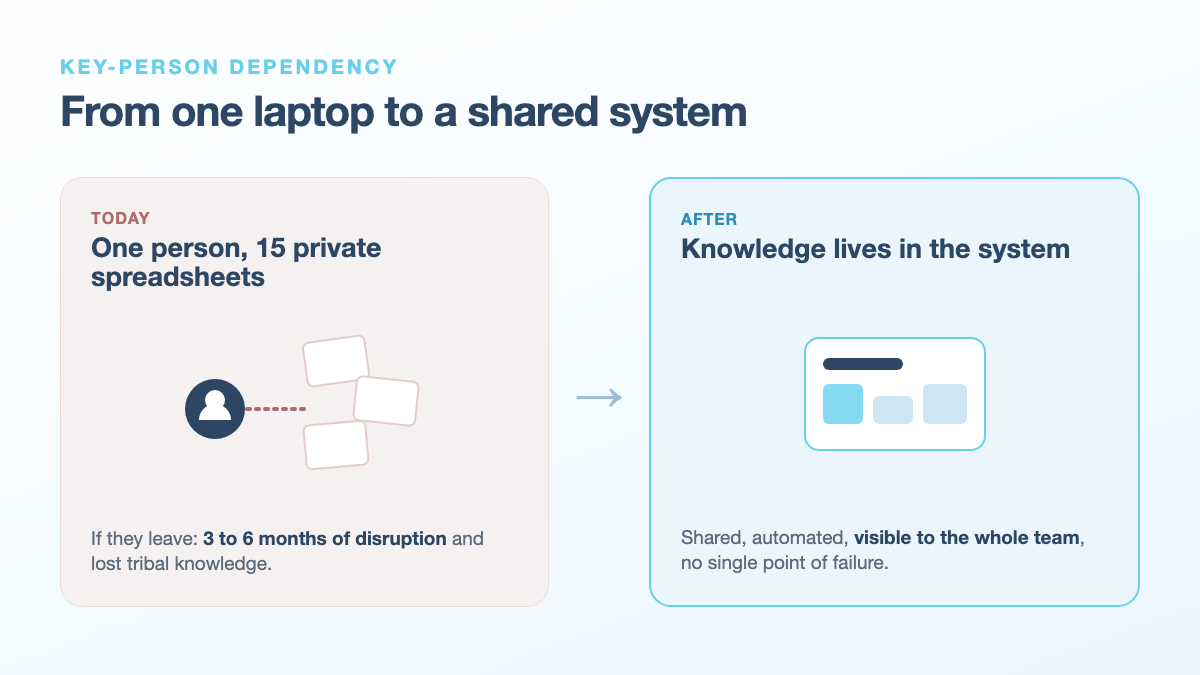
That is tribal knowledge, the unwritten operational know-how held in people's heads rather than in a system. It works until that person takes a vacation, gets sick, or quits. Then the business discovers how much was never written down, and how fragile the operation really was.
What Does It Actually Cost When a Key Operations Manager Leaves?
More than most owners expect. Employee turnover cost, the full cost of replacing a worker, runs 50 to 200% of their annual salary once you count hiring, lost productivity, and ramp time (SHRM and Gallup). For a hard-to-replace operations manager, the real disruption is 3 to 6 months of degraded operations while the role refills and relearns.
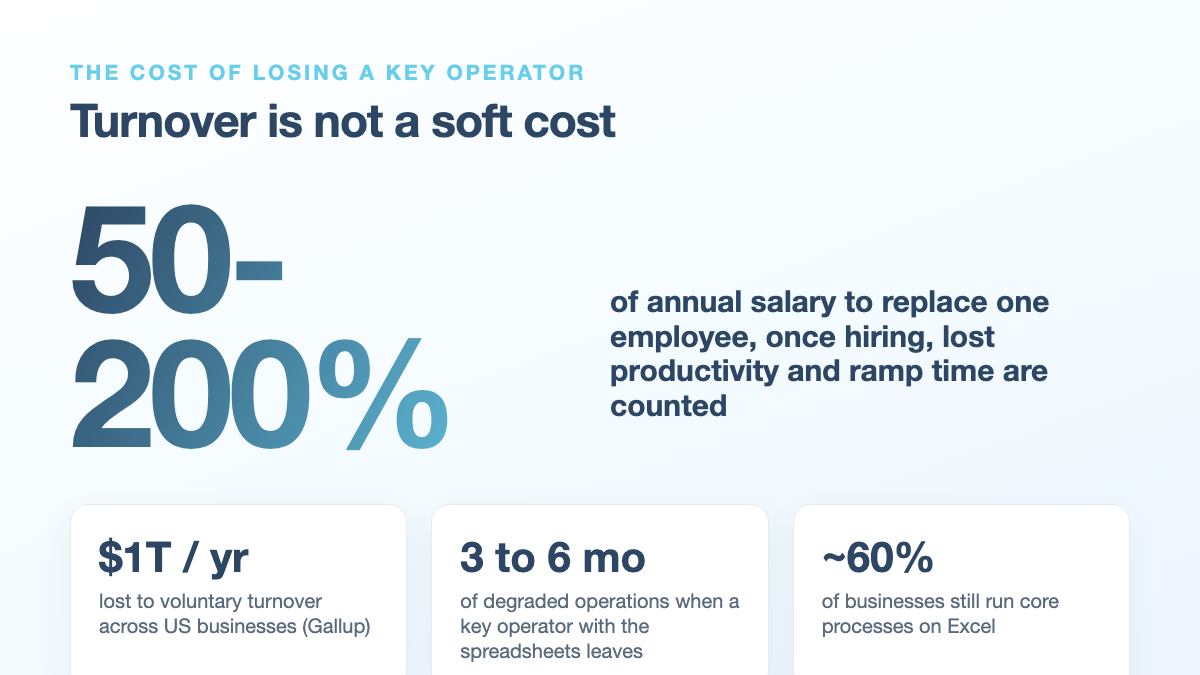
Voluntary turnover costs US businesses about $1 trillion per year (Gallup). When the person who leaves is also the one holding the spreadsheets, the cost compounds: you are not just replacing a hire, you are rebuilding lost tribal knowledge. Employee retention, keeping your key operations staff, is cheaper than any rehire.
How Do Outdated Tools Push Your Best People to Competitors?
By wasting their expertise on repetitive work. Your best operators did not join to copy data between screens and rebuild the same report every week. When the tools do not improve, the message they hear is that the business will not invest in them. Frustration with repetitive manual work is a top, and fixable, driver of voluntary exits.
Competitors with modern tooling use exactly this gap to recruit. They offer the same operator a role where the system does the routine and the person does the judgment. If your software makes your best people feel like data-entry clerks, you have made that pitch for your competitor.
How Do You Reduce the Manual Work Without Replacing Your Whole System?
You automate the routine on top of the system you already run. Process automation, removing the repetitive manual work, takes the 70% of a person's day that is copy, paste, and reconcile and hands it to a layer that reads from your ERP. The expert keeps the judgment work. The spreadsheets move into a shared system everyone can see.
This does not require an ERP replacement. A focused legacy workflow modernization sprint automates the manual steps your team works around today, and a reporting layer sprint replaces the private spreadsheets with one shared, trusted view. The knowledge moves from a laptop into the operation, where it belongs.
Are Private Spreadsheets Really That Risky to Leave in Place?
Yes, on two fronts. They are an operational risk, because the logic and data sit with one person and vanish when that person does. They are also a decision risk: leadership cannot trust numbers trapped in private files, and conflicting versions between the ERP and shadow spreadsheets create errors. The spreadsheet that feels efficient today is the single point of failure tomorrow.
The Bottom Line: Your Tools Are a Retention Problem
If your best people are holding operations together with private spreadsheets, that is not loyalty you can count on. It is risk you have not priced. Ask your team which manual process frustrates them most, then automate it. 3ALICA moves that routine into a shared layer on top of your current system in a 4 to 8 week sprint, so the knowledge stays in the business and your best people stay too.
Giving those people a view that matches how they actually work is the Operational KPI Sprint.