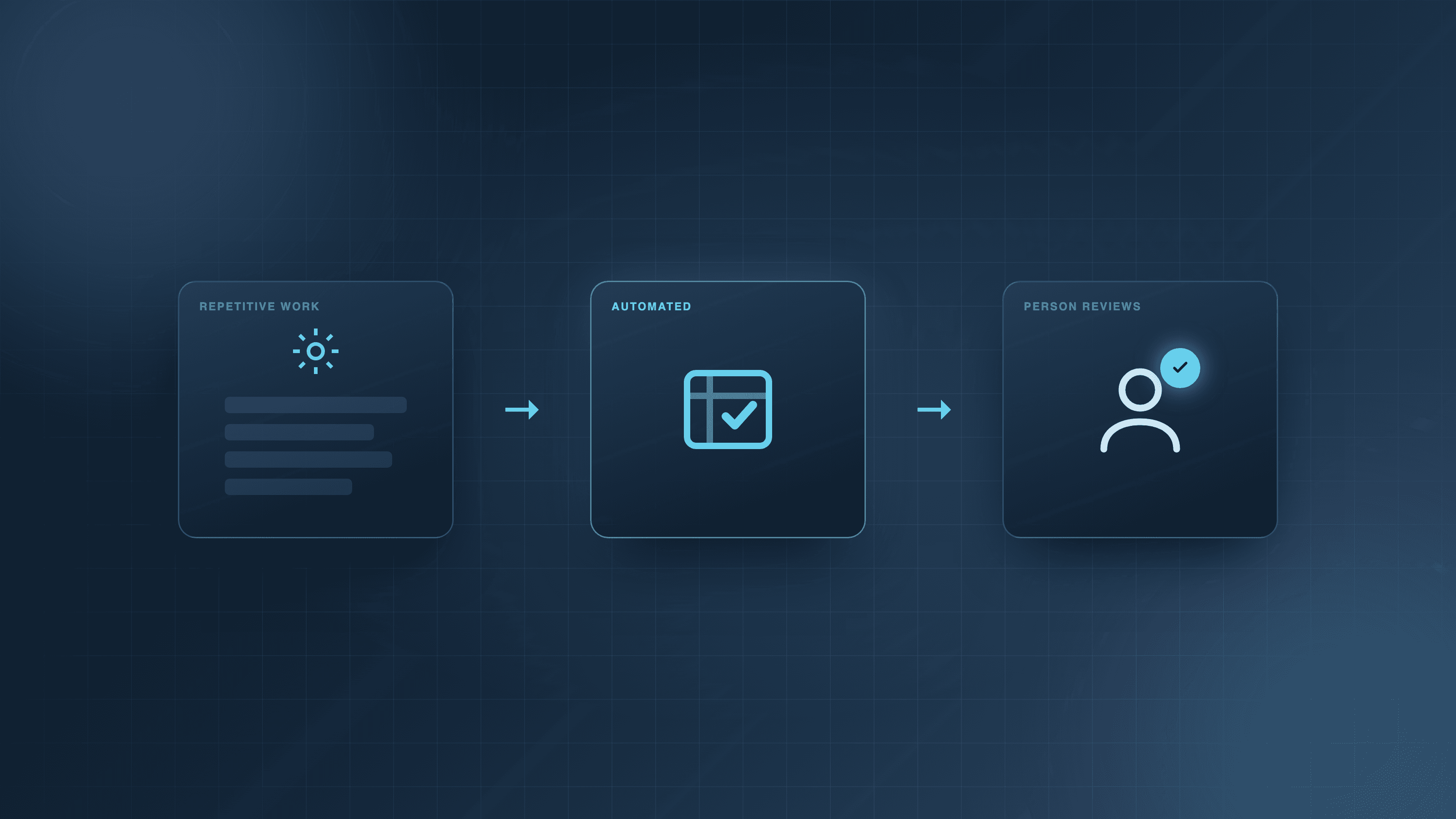
Automating a task replaces the busywork, not the person. An order entry clerk stops re-keying data by hand and starts checking and correcting it. That distinction is the whole game: the automation that sticks changes the role, not the headcount, and it starts with the manual work a team already wants gone. Most automation that stalls in a small business stalls on trust, not on technology.
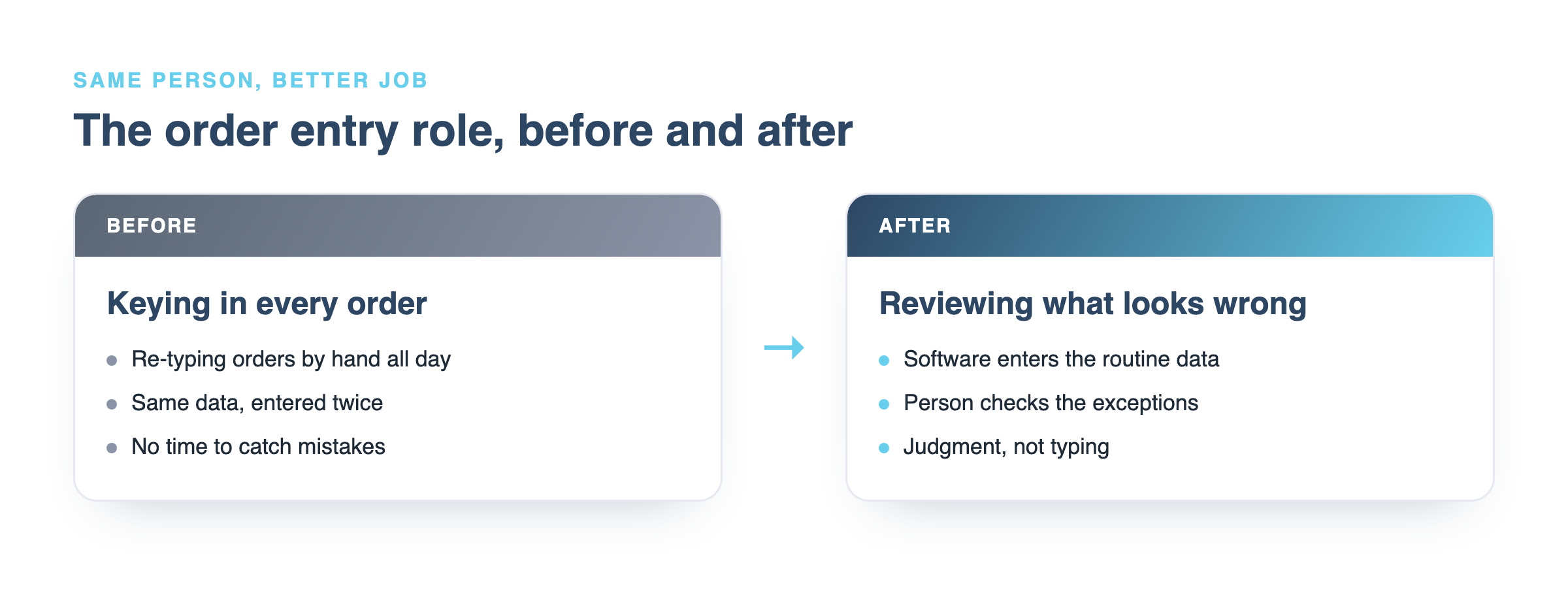
Automation fails on people, not technology
When automation stalls in a small or mid-sized business, the cause is rarely the tool. It is the rollout. Roughly 70% of transformation efforts fall short, and the leading reasons are employee resistance and weak management support, not the technology (McKinsey). The ground is harder now: 73% of organizations are already near, at, or beyond change saturation (2026), so a team may simply be tired of new systems that never got finished. Workflow automation, having software do the repetitive steps in a recurring task, is usually the easy part. The human part is the project.
The fear is reasonable, not irrational
The worry a team feels is earned. People have watched systems get bought, half-installed, and abandoned, and they have heard "this will make things easier" before. The first fear is also real and rising: 40% of employees now fear losing their job to AI, up from 28% in 2024 (Mercer Global Talent Trends 2026). Mercer has a name for it, the fear of becoming obsolete. Much of the resistance is about trust, not the tool: among employees who resist change, 41% cite distrust in leadership and 23% say they felt excluded from it (2026). Employee resistance, a team's caution toward a change that has burned them before, is a rational response to that history, not stubbornness. Naming those fears honestly, instead of talking around them, is where trust starts.
Automate the routine, not the role
The reframe that changes everything is simple: automate the task, not the person. Manual data entry, re-keying orders, counts, and reports by hand, is work almost no one enjoys, and taking it away does not remove the job. It changes it. The order entry clerk stops typing and starts reviewing exceptions, catching the orders that look wrong. That is role redesign, the same person shifting from doing the repetitive work to checking and correcting it. The signal from the data supports it: even as AI automates specific tasks, most workers still believe their overall role stays secure. The task gets automated, not the person. Our piece on why operations people quietly resent their software covers the other side of the same trust problem.
Start with the work the team already hates
The safest first automation is the one the team is already tired of doing. The part of a job people most want gone is the repetitive part, so removing it first is not a trick, it is respect. It also makes the win easy to see, and no one is left defending the manual version. In distribution that is usually one of four things: manual data entry, report generation, inventory counting, or order processing. In our automation work with operators, the projects that hold are the ones that begin with the task the team volunteers first, shown in our process automation case.
A rollout that earns trust instead of forcing it
Good change management for a small business is not a big program. It is four steps that keep the team in control.
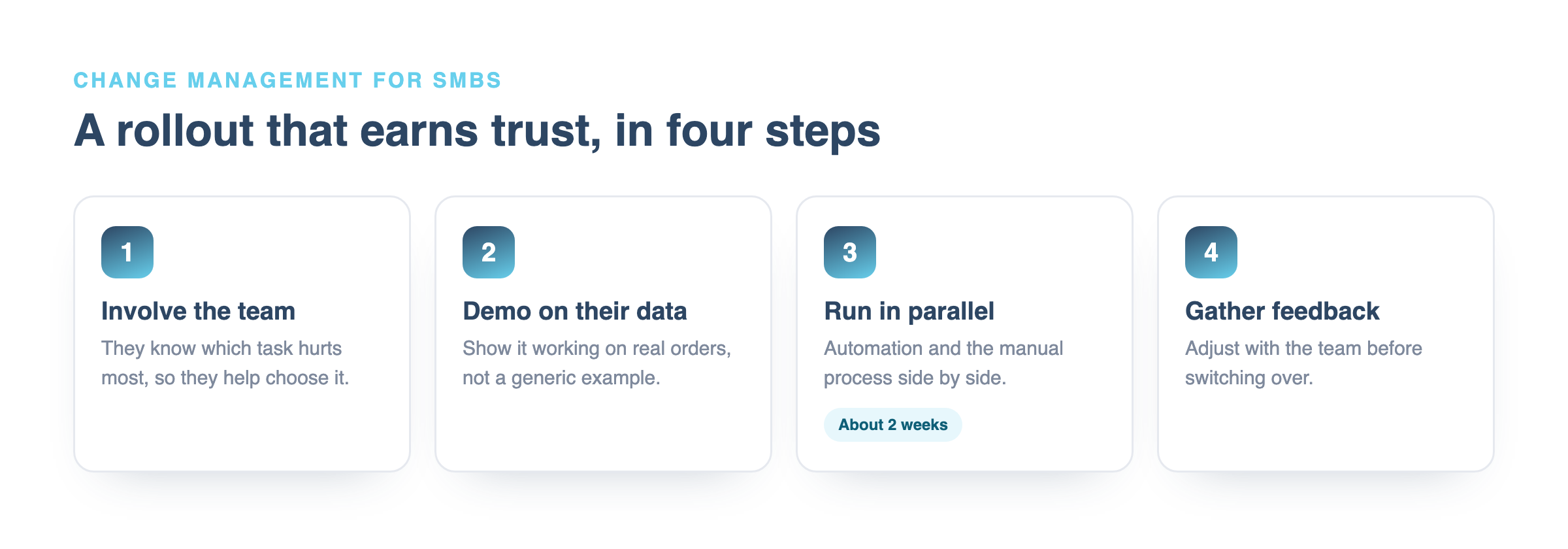
First, involve the team in choosing the process, because the people who do the work know which task hurts most. Second, demo the automation on their own data, not a generic example, so they can see it is real. Third, run it in parallel, the automation and the manual process side by side, for about two weeks, so nothing depends on it until it has earned trust. Fourth, gather feedback and adjust before switching over. Done this way, adoption is not forced. It is chosen.
The role changes, it does not disappear
Mercer's own conclusion from the 2026 data is to empower talent and redesign work, not cut it (Mercer, 2026). Automation that removes the drudgery and leaves the judgment is the version people accept, because it makes their day better. The tedious hour goes and the part that needs a person stays. The job title does not change. The worst part of the job does. That is the version worth building, and it is also the version that lasts, because the team is on its side rather than working around it.
Frequently asked questions
Why does automation fail in small and mid-sized businesses?
Usually not because of the technology. Roughly 70% of transformation efforts fall short, and the leading causes are employee resistance and weak management support, not the tools (McKinsey). In a small business, that shows up as a system nobody adopts. The fix is a rollout that earns the team's trust, starting with a task they already want gone, rather than a tool forced on them.
Which process should a team automate first?
The one that takes the most time and annoys the team the most. In distribution that is usually manual data entry, report generation, inventory counting, or order processing. Starting with the task people already dislike removes real pain and builds trust for the next step. It is also the safest first project, because success is easy to see and no one is defending the manual version.
Does automation replace the person doing the task?
No, it replaces the repetitive part of the task. The person shifts from doing the work by hand to checking and correcting it. An order entry clerk stops re-keying orders and starts reviewing the ones that look wrong. Even as AI automates specific tasks, most workers still expect their overall role to hold (Mercer, 2026). Built this way, automation adds to a job rather than removing it.
How do you get a team to accept automation?
By keeping them in control of it. Involve the team in choosing which process to automate, demo it on their real data, run it in parallel with the manual process for about two weeks, and gather feedback before switching over. Naming the real fears honestly matters too, since much resistance comes from distrust rather than the tool. Adoption follows when the change is done with the team, not to them.
What is a parallel run and why does it matter?
A parallel run is when the automation and the existing manual process operate side by side for a period, usually a couple of weeks. Nothing depends on the automation until it has proven itself against the old way. It lets the team compare results, catch issues, and build confidence with no risk. It is one of the most effective ways to turn a feared change into a trusted one.
Where to start without scaring anyone
The safest first automation is the one the team is already tired of doing by hand. It removes real pain, frees hours for better work, and proves the approach before anything bigger. If a manual process is quietly draining a team, that is the place to begin, with the people who do the work rather than around them. 3ALICA builds automation on the systems a company already runs, one trusted step at a time.
Sources
- Mercer, Global Talent Trends 2026: employee concern about losing a job to AI rose from 28% in 2024 to 40% in 2026
- McKinsey, common pitfalls in transformations: most fail on people, not technology
Rebuilding one manual workflow without replacing the systems around it is the Workflow Automation Sprint.