
A poor cooling season forecast costs HVAC distributors in two directions at once. Overstock ties up cash that costs 20% to 30% of its value a year to hold, while understock triggers emergency buys, lost customers, and rebate margin left on the table. A forecast built on your own branch mix and customers, not last year's spreadsheet, closes most of that gap.
The cooling season decides your whole year
For an HVAC distributor, the cooling season (the warm months, roughly April to September, when air conditioning demand peaks) carries the majority of annual volume. Miss the forecast for those months and you cannot make it back in the fall. Weather is the swing factor: HARDI members saw regional sales differ by 25 percentage points between the warmest and coolest markets in a single period (ACHR News, 2026), and an early-warm April recently pushed distributor sales up 4.5% year over year (Distribution Strategy Group, 2026). Demand forecasting here means predicting how much of each product your branches will sell so you buy the right amount, not too much and not too little.
A bad forecast leaks cash two ways
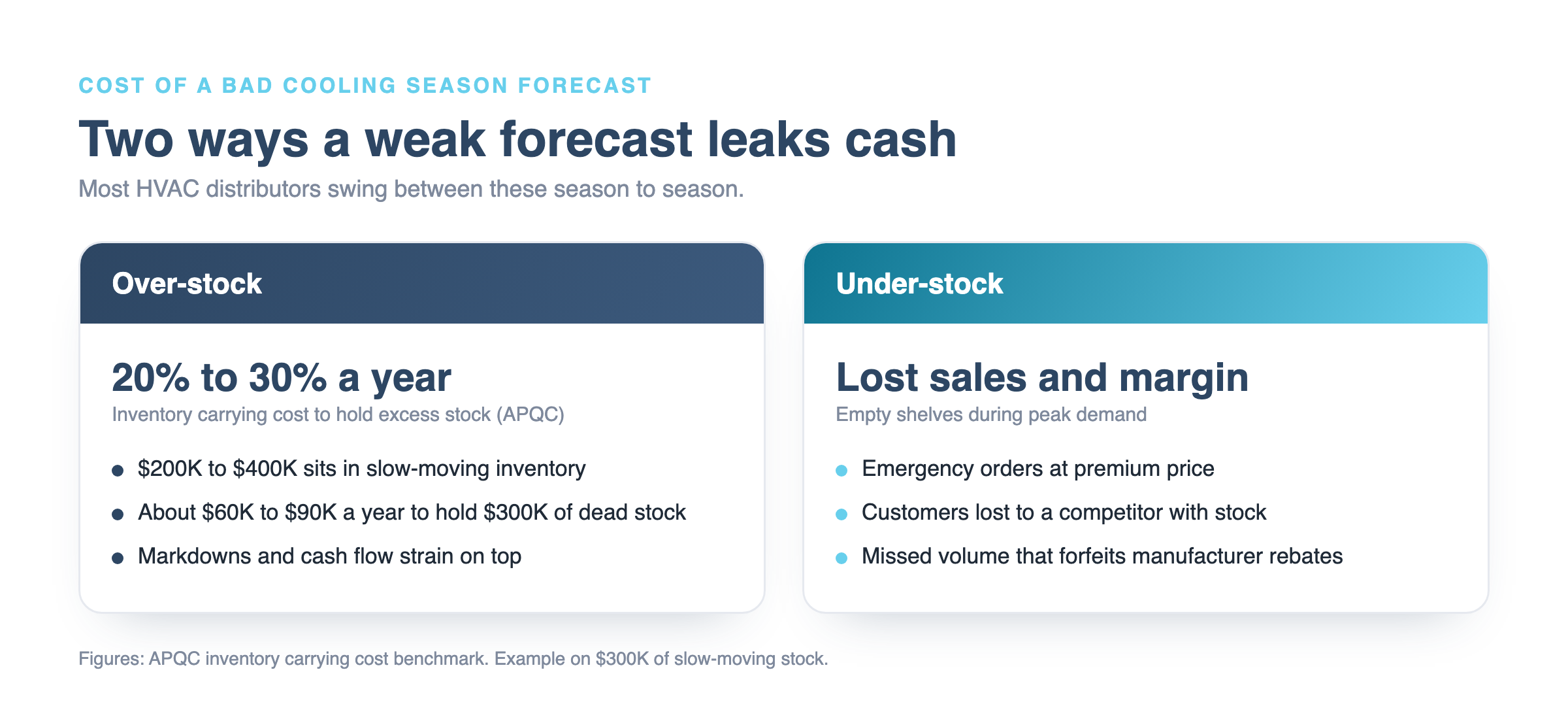
Get the number wrong and you land in one of two costly scenarios. Overstock buries cash in product that sits. Understock costs you the sale and the customer. Most distributors swing between them season to season.
| Scenario | What happens | What it costs |
|---|---|---|
| Over-stock | $200K to $400K sits in slow-moving inventory | Inventory carrying cost of 20% to 30% a year to hold, plus markdowns and cash flow strain |
| Under-stock | Shelves empty during peak demand | Lost customers, emergency orders at premium price, and missed volume that forfeits rebates |
Inventory carrying cost (the yearly cost of holding stock: tied-up capital, warehousing, insurance, and obsolescence) runs 20% to 30% of inventory value a year (APQC). On $300K of dead cooling season stock, that is roughly $60K to $90K gone in a year just to hold it. Dead stock (product that sits long enough to tie up cash and risk obsolescence) is the quiet tax on an over-optimistic forecast.
Why experience and Excel stop working
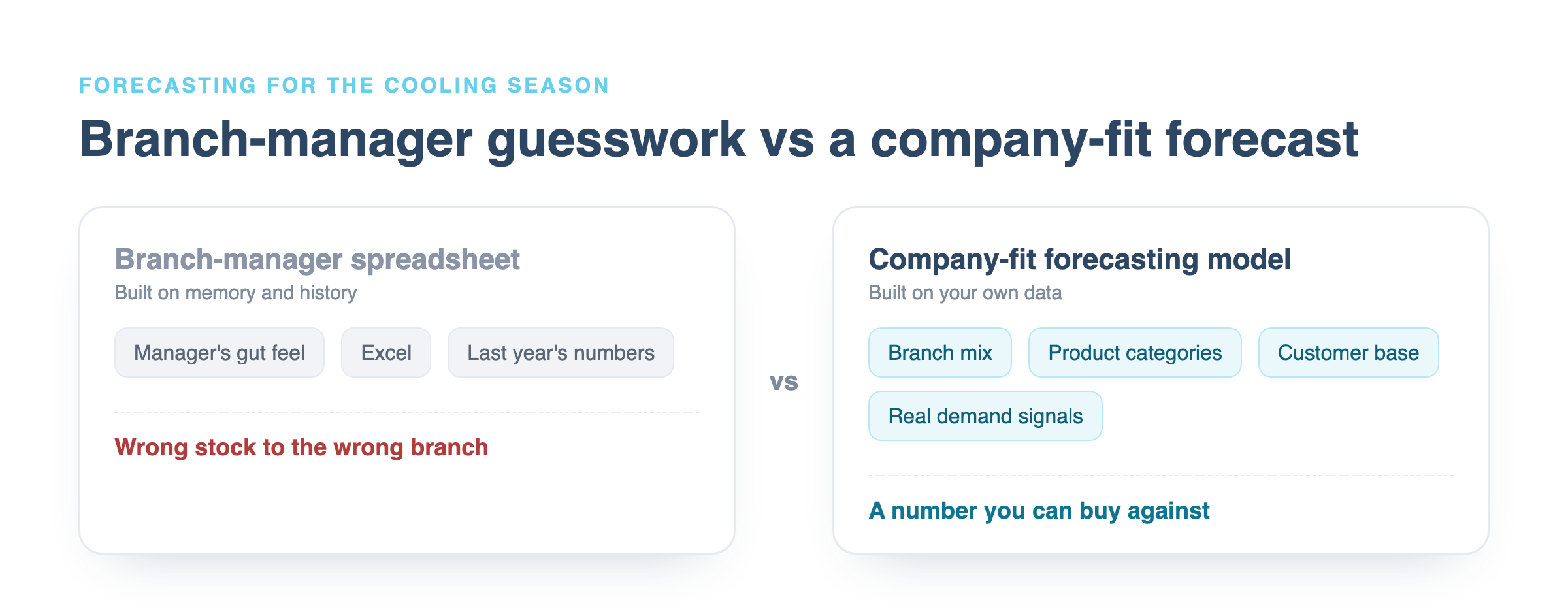
Most cooling season forecasts still run on three inputs: the branch manager's gut, a spreadsheet, and last year's numbers. That worked when the season looked like the one before it. It breaks the moment conditions change. Last year's numbers do not see this year's weather patterns, local builder activity, or the contractor pipeline feeding your counter. When those move, a forecast anchored to history sends the wrong stock to the wrong branch.
What a custom forecast looks like
A custom forecasting model (a forecast built on one distributor's actual branch mix, product categories, and customer base, rather than a generic template) uses the data you already generate. It weighs each branch, each product category, and real demand signals instead of a single manager's memory. 3ALICA builds a practical operational data, BI, and automation layer around the systems a company already runs, in 4 to 8 week sprints, without replacing the ERP.
In our forecast-accuracy work with HVAC distributors, the gap is almost always the same: the cooling season plan lives in one branch manager's spreadsheet, built on last year's totals. One multi-brand HVAC distributor we worked with forecast by hand, branch by branch, carrying excess stock in some locations while running out in others. We built a custom forecasting model on its existing ERP and cut forecast prep by 40 to 60%, with a 12-month view across branches, in a 6 to 8 week sprint. You can see that work in our HVAC forecast accuracy case and in the Forecast Accuracy Sprint.
The rebate money hiding in a better forecast
A sharper forecast also protects money you have already earned. A meaningful share of manufacturer rebate margin goes unclaimed across distribution, because most ERP systems cannot track rebate earnings in detail and the work falls to a spreadsheet. Hit your volume tiers on purpose instead of by accident, track what you are owed, and that margin stops leaking. For the data plumbing behind this, see how we handle predictive inventory for HVAC seasonality.
Frequently asked questions
What share of HVAC distributor sales happens during cooling season?
The cooling months, roughly April to September, carry the majority of annual HVAC volume, which is why a miss there cannot be recovered later in the year. The exact concentration varies by region and product mix, so confirm your own split from your sales history. Weather drives the swing: regional sales have differed by 25 percentage points between the warmest and coolest markets in one period (ACHR News, 2026).
How much does overstocking actually cost an HVAC distributor?
Holding excess stock costs 20% to 30% of its value a year, covering tied-up cash, warehousing, insurance, and obsolescence (APQC). On $300K of slow-moving cooling season inventory, that is about $60K to $90K a year just to hold it, before any markdowns needed to clear it. That is cash that cannot fund the next season's buy.
Why do branch-manager and spreadsheet forecasts fail for cooling season?
They lean on experience, last year's numbers, and a spreadsheet, so they cannot see this year's weather patterns, local builder activity, or the contractor pipeline. When conditions shift, a forecast anchored to history sends the wrong stock to the wrong branch. It is not a discipline problem. The inputs simply do not capture what actually drives demand.
What is a custom forecasting model for HVAC distribution?
It is a forecast built on your own branch mix, product categories, and customer base rather than a generic template or a single manager's memory. It uses the data your systems already generate, weighs each branch and category, and factors in real demand signals. The goal is a number you can buy against with confidence, not a spreadsheet guess.
How do HVAC distributors lose rebate margin?
Rebate margin leaks when volume tiers are tracked by hand. Most ERP systems cannot follow rebate earnings in detail, so the work falls to spreadsheets, and earned dollars go unclaimed or unnoticed. A forecast that shows where volume is heading lets you plan buys toward the tiers you can actually hit and track what each manufacturer owes you.
Getting your cooling season forecast ready before April
Cooling season is coming, and the forecast you set now decides how much cash you tie up and how much margin you keep. 3ALICA builds a custom forecast on the data you already have, in a focused sprint, without replacing your ERP. Send us the branch and product mix that worries you most and we will show you where the risk sits.