AI Factory
Deliver more engineering work on tighter budgets.
Our team takes one repeatable engineering task, such as migrating a batch of reports, and delivers it with the AI Factory. Every change is checked and handed over with evidence, and you pay per completed change.
Delivery partners win client work they used to lose on price and keep the client. Engineering teams clear work their headcount cannot reach and keep the factory.
Senior-led. AI-assisted.
Example: one completed change
Move the monthly revenue report
- Scope matches the approved request
- The check failed on purpose before it was trusted
- The check passed on the exact commit
- Diff, results, logs and a short explanation attached
Status
Ready for your reviewer
Priced as
One completed change
The problem
The work is clear. The budget cannot carry the delivery cost.
For a delivery partner it shows up at the proposal stage: the client is ready, and the estimate lands above the budget or past the deadline. For an engineering team it shows up in planning: the backlog is known, and the headcount to clear it is not there.
Each usual answer costs you something
Hire for it
The budget has to carry that headcount, busy or not.
Pass or postpone
The deal goes to a competitor, or the backlog waits another quarter.
Go with cheaper staff
Quality becomes the risk your client or your users see.
Smaller budgets need a better production system, not cheaper engineers.
The AI Factory
One repeatable task. Every change checked. A price per completed change.
One repeatable task
We start with one engineering task the work repeats, such as migrating a batch of reports. Each change in it is small, bounded and done the same way every time.
Checked, with evidence
Every change arrives with its diff, check results, logs and a short explanation, tied to the exact commit.
Priced per completed change
You pay for completed changes, not for a full team’s months on the project. That is how the work fits a tighter budget.
We trust a check only after we have watched it fail on purpose.
Today
- Priced by team size and months
- You hire, pass or go with cheaper staff
- Cost grows with headcount
With the AI Factory
- Priced per completed change
- Every change handed over with evidence
- Your brand and client, or your team and codebase
How it works
Follow one change from request to handover
Agree one task
Your product owner approves what a change must do and how it is accepted, before any code exists.
Build and check
Our team builds the change with AI assistance in an isolated workspace. The deciding check must fail on purpose before it is trusted.
Review the evidence
The change arrives as a pull request with its diff, check results and handover notes, tied to the exact commit.
Accept or return
Your reviewer accepts or returns it. Whoever lands a change cannot release it alone, and a plain revert restores the last good build.
People decide what gets built, accept the evidence, own the release and answer to the client. During a pilot, a person reviews every change.
Read the full method: what an AI factory is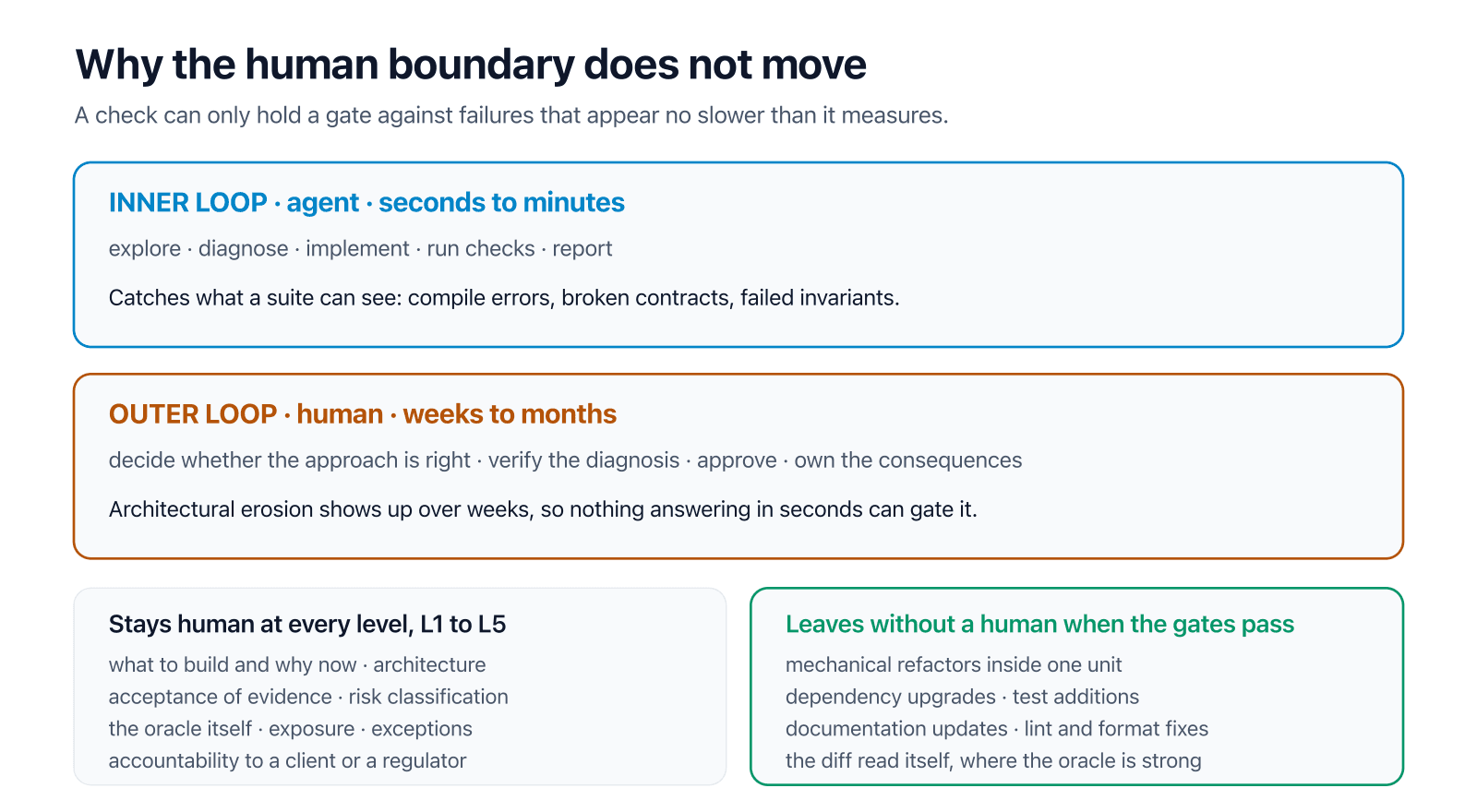
Who it is for
Two ways to use the AI Factory
Delivery partners
- US MSPs, ERP and business-systems integrators, and data, BI or software consultancies.
- Client work your current delivery model cannot price profitably.
- Your engineers work in the factory, or ours under your brand. The client stays yours.
Engineering teams
- CTOs and engineering leaders with a backlog of repeatable work.
- A repository you own, with checks or the will to build them.
- Our engineers build the factory inside your team, and your engineers keep it.
Not for
- Staffing requests looking for cheaper hands.
- One-off tasks with no repeatable delivery pattern.
- Buyers who want delivery with no person accountable for it.
Proof
Selected work our team delivered with the AI Factory
Within 0.01%
Spend and revenue reconciliation
Hundreds of ads go live in minutes, and about 60 automated data checks watch the numbers.
About a day
Release stabilization, down from weeks
Several features ship a day.
69% to 92%
Commits within the change-size ceiling
After our team added controls to the live codebase.
About 40%
Lower projected cost than the conventional fixed-price proposal
The first build came about 2 weeks earlier.
How an engagement starts
Start with one project. The factory goes live in four weeks.
Step 1
A 15-minute call
Bring one project or backlog and tell us which engineering task in it repeats. We tell you whether it fits the AI Factory.
Step 2
Scope one task
We agree what counts as a completed change in that task, how it is accepted and how it is priced.
Then the build, four weeks on that task
Week 1
Measure and build one reliable check
We score the repository against the readiness model, then build one check and prove it can fail: break the behavior on purpose, and its tests go red.
Week 2
Contain the agent and set the ceiling
Restricted tools, an isolated workspace and a recorded base commit. The change-size ceiling comes from the repository’s own merge history.
Week 3
Wire the gates and rehearse the revert
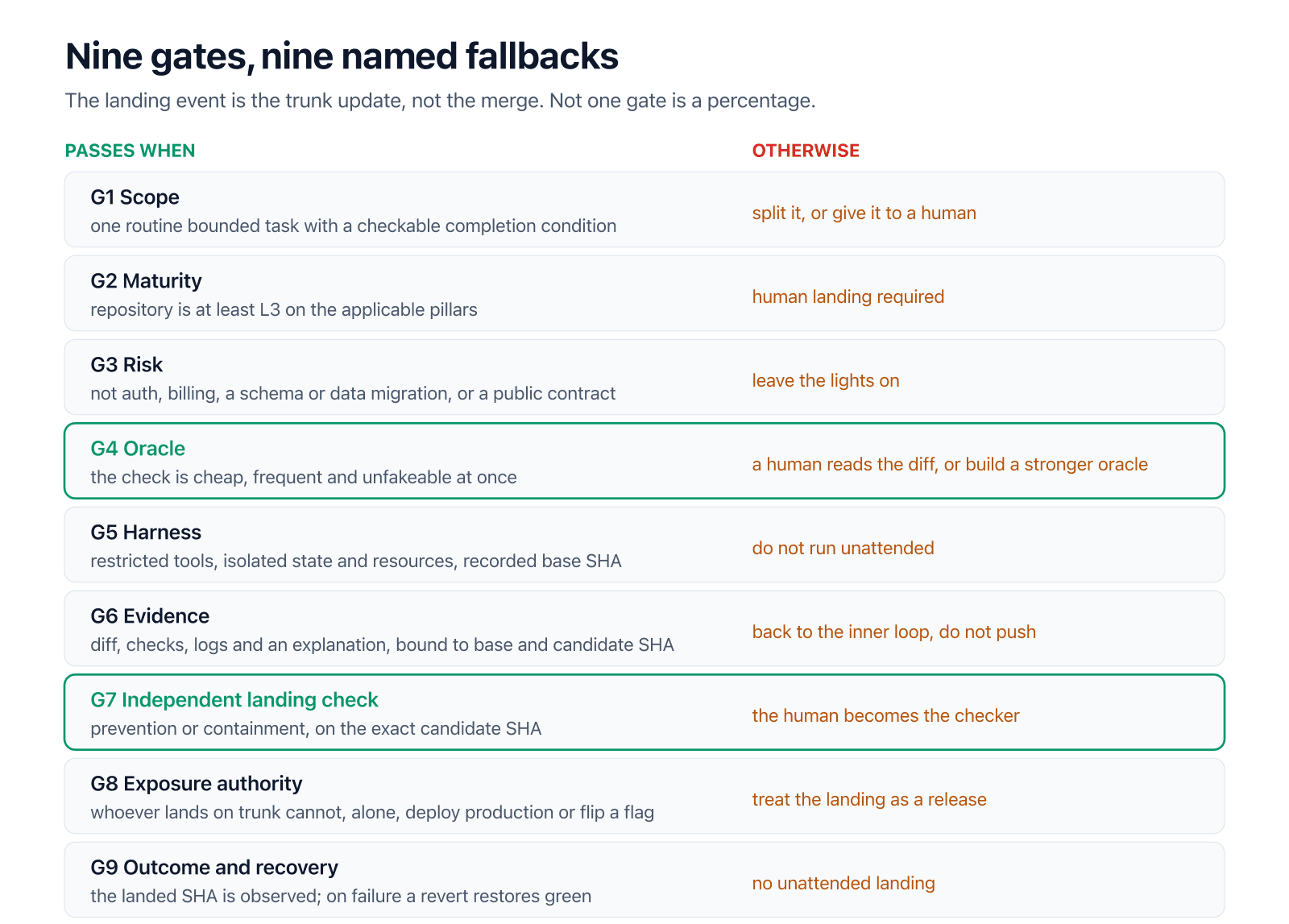
The nine gates go in, and the team practices the revert until restoring a green build is routine.
Week 4
Prove it on one real change
One real change from the backlog goes through every step with its evidence attached. During the pilot, a person reviews every diff.
The four weeks assume reliable checks and the required repository readiness. We scope any gaps first. After week 4, delivery runs change by change, priced per completed change.
Engineers already run the task?
Start with the free two-hour pilot design workshop
We price one recurring task as cost per completed change and decide together whether a pilot is worth running at all. No system access is needed.
Questions
Before you bring us a project
How is the work priced?
Per completed change. We agree the scope and acceptance criteria upfront, before you quote your client or plan the quarter. A completed change meets those criteria and carries the agreed evidence.
Who does the work, and whose name is on it?
Your engineers can work in the factory, or ours work under your brand. The client relationship stays with you, with NDA, non-solicit and non-circumvention terms where needed. Our engineers can also join your delivery team as Forward Deployed Engineers.
See how the pod worksWhat if the task is not ready for the factory?
Then we say so before the build starts. If a class of change has no reliable check, we scope that work first or keep the change with a person.
What can an agent do on its own in our repository?
It has no route to push to your trunk. Every change arrives as a pull request behind your existing branch protection, and the principal that lands a change cannot release it. Autonomy is granted to a class of task, never to a repository, and each class is bounded by a size ceiling taken from your own merge history rather than a policy number.
How long does the factory take to stand up?
There are two separate timelines. The factory itself goes live in 4 weeks. Delivery through it runs on its own schedule after that. The 4 weeks assume the agreed class of change already has a reliable check and the repository meets the readiness level that gate G2 requires. If either condition is missing, we scope remediation first.
How do you protect our code from LLM exposure?
We use enterprise endpoints with documented data-use and retention terms, or deploy inside your environment. We do not opt client code into model training, and the data boundary and retention settings are agreed before access is granted.
Can you work on our own infrastructure and models?
Yes. We deploy against your cloud, your VPC, and your model endpoints, including open-weight models hosted on your own infrastructure via vLLM.
Who owns the code and IP?
You own the code, prompts, evals, runbooks and project artifacts we create for you from the first commit. Pre-existing components, open-source libraries and third-party models stay under their existing licenses, with usage rights set out in the agreement.
Get in touch
Bring a project your delivery estimate cannot fit
Tell us which engineering task in it repeats and where the budget, deadline or headcount stopped it. In 15 minutes we can say whether it fits the AI Factory, or why it does not.
Email us directly
sales@3alica.com