When tariffs keep changing, SMB distributors should manage inventory from real-time landed-cost and stock data rather than fixed rules of thumb, because the number that decides how much to buy and what to charge is moving underneath them. As of July 2026 the average US effective tariff rate is 7.2 percent, but that average hides wide swings by country and product, and the legal ground keeps shifting. A distributor still setting buffer stock and prices off last quarter's costs is buying blind. The distributors holding up are the ones who can see current landed cost and current inventory in one place and act on both quickly.
Where tariffs actually stand in 2026
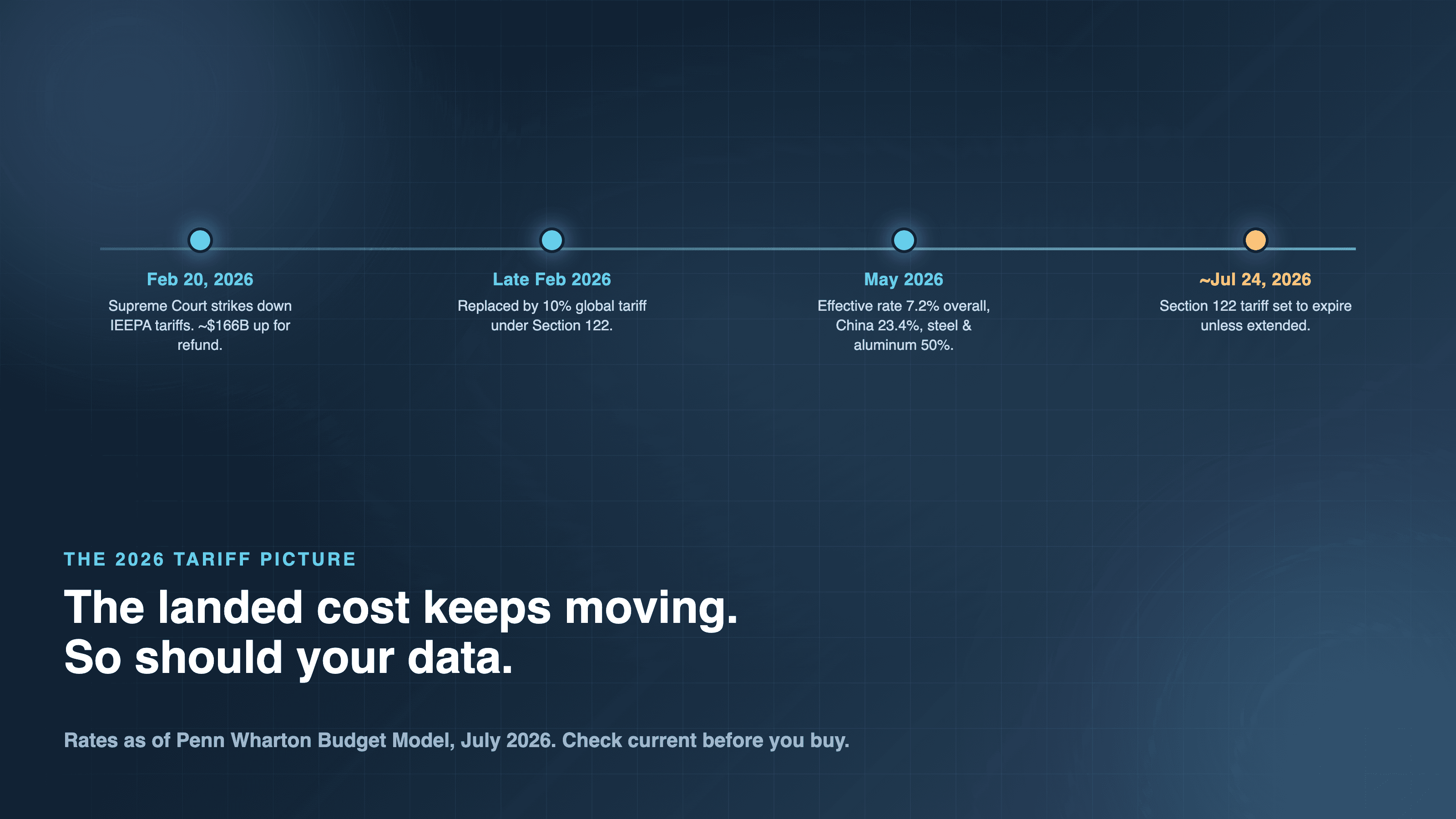
The picture as of mid-July 2026 is both lighter than a year ago and far less settled. The average effective tariff rate was 7.2 percent in May 2026, with China the highest among major partners at 23.4 percent, according to the Penn Wharton Budget Model. Goods from Mexico and Canada that qualify under USMCA still enter at zero, and 83.8 percent of imports from those countries claimed that exemption. Section 232 tariffs on steel and aluminum are the heavy hitters, sitting at 50 percent, which the Penn Wharton model puts at a 41.2 percent effective rate for that category.
What makes 2026 different is the instability underneath the numbers. On February 20, 2026, the Supreme Court declared the IEEPA tariffs unconstitutional, putting roughly $166 billion of collected duties in line for refunds, and those tariffs were replaced by a 10 percent global tariff under Section 122 (Penn Wharton). That Section 122 tariff carries a 150-day statutory limit that runs out on July 24, 2026, and as of mid-July no extension was pending in Congress. Rather than extend it, the administration signaled a shift toward a Section 301 replacement, with proposed duties of 12.5 percent on imports from 46 countries, so even the mechanism meant to replace it was unsettled. Either way, the point holds: the landed cost of a container ordered today may not be the landed cost when it arrives. Any number in this article is accurate to its date and should be checked against current rates before a buying decision, which is exactly the point: the rates move, so the data has to be live.
What it means for HVAC distributors
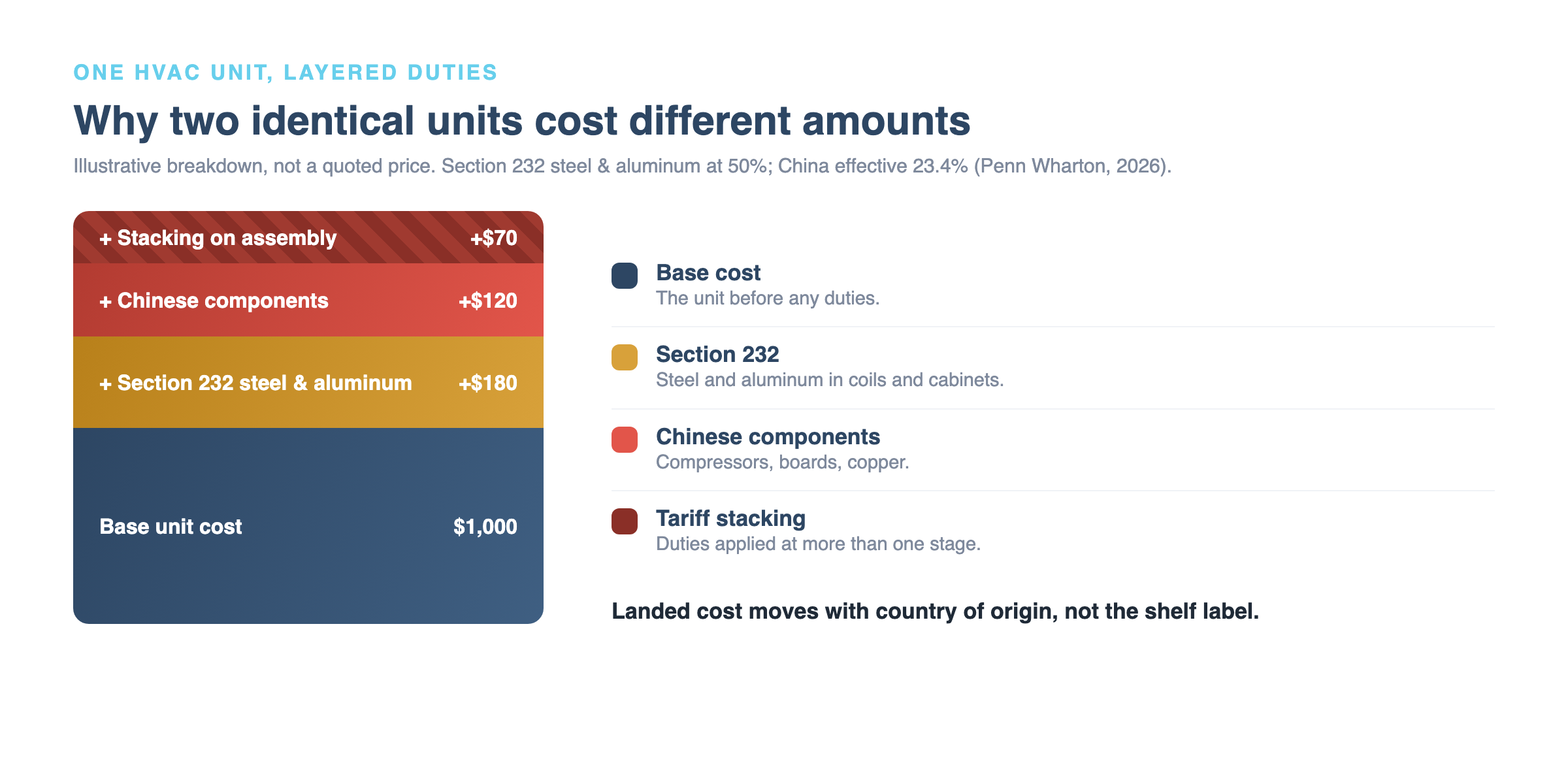
HVAC is exposed on almost every line of the bill of materials. Even a system assembled in North America relies on imported compressors, circuit boards, and copper, and steel and aluminum tariffs touch the coils and cabinets directly. Industry reporting puts HVAC equipment prices up 15 to 30 percent since mid-2025 on layered tariffs. The trickier problem is tariff stacking: a heat pump assembled in Mexico from Chinese-sourced components can pick up duties at more than one point, so two units that look identical on a shelf can carry different landed costs depending on where their parts came from.
For a distributor, that lands on margin in two places. First, replacement stock costs more than the units already sold, and industry reports say pre-tariff inventory has largely been depleted, so new purchases carry the full adjusted cost. Second, if pricing is not updated as landed cost moves, quotes go out at margins that no longer exist. This is the same seasonal-plus-cost visibility problem we covered in why a bad cooling-season forecast costs up to 30 percent a year in overstock, now with a moving cost input on top of moving demand.
What it means for food distributors
Food distributors feel tariffs less through ingredients and more through everything wrapped around the product. Steel and aluminum duties raise the cost of cans, lids, closures, and processing equipment, and canned goods saw some of the sharpest grocery price increases at the end of 2025 (American Action Forum). Conagra told investors that inflation and the tariff environment would add roughly 3 percent to its cost of goods sold, more than $200 million a year, in 2026. There is also an indirect channel: tariffs on equipment and fuel-linked costs feed into freight, and distribution is freight-heavy, so a cost increase that starts at the border shows up again in the cost to deliver.
The through-line for both industries is that the cost of a product is no longer a stable number a distributor can memorize. It changes with policy, with country of origin, and with which supplier filled the order. The margin math we walked through in why 15 to 25 percent of distribution routes run at a loss gets harder when the cost side is also moving.
Three moves an SMB distributor can make
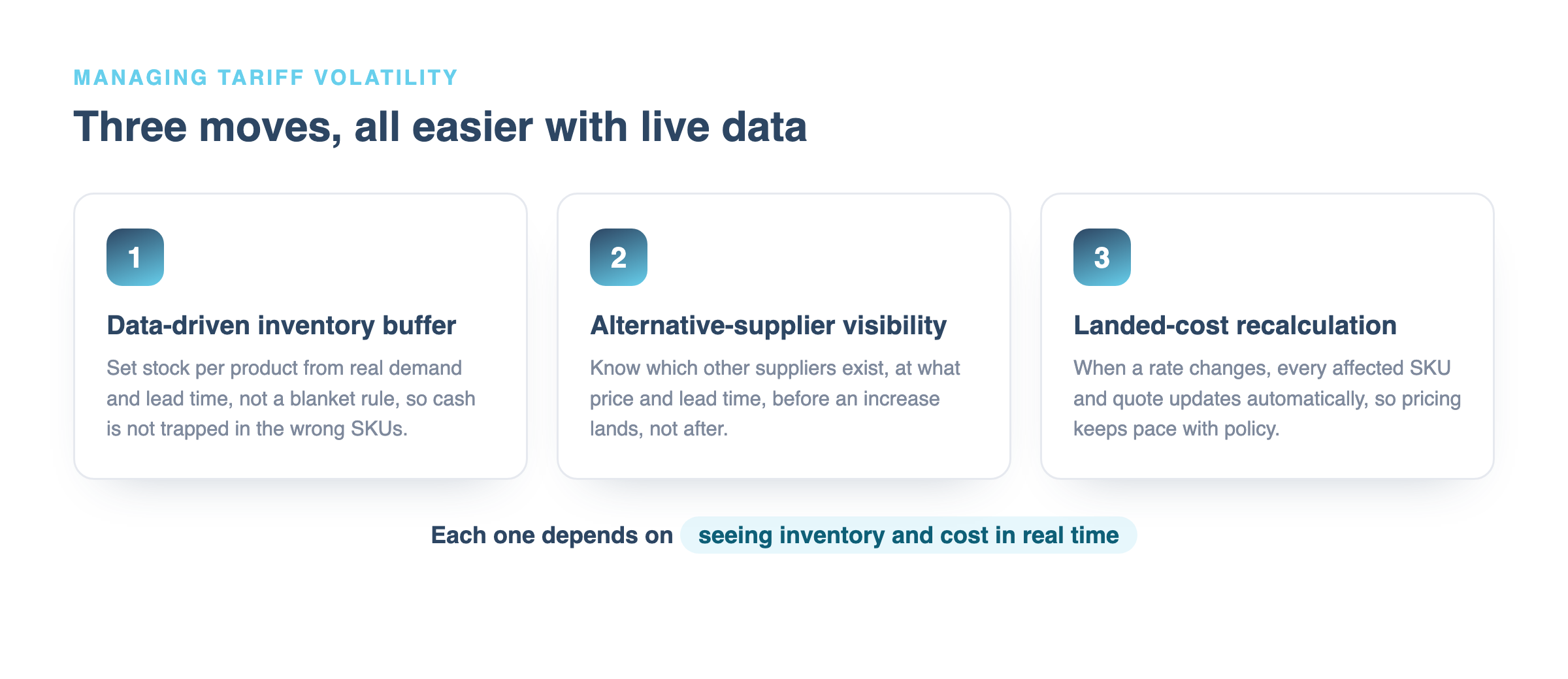
There are three practical responses, and all three get easier with better data. The first is a smarter inventory buffer. Holding more stock hedges against the next tariff increase, but cash tied up in inventory that may face a refund or a rate cut is its own risk, so the buffer should be set from real demand and real lead times per product, not a blanket rule. The second is alternative-supplier visibility. When one country of origin gets more expensive, the distributors who can move quickly are the ones who already know which alternative suppliers exist, at what price, and with what lead time, rather than starting that search after the increase lands. The third is landed-cost recalculation. When a rate changes, the landed cost of every affected SKU and the margin on every affected quote should update without a manual spreadsheet pass, so pricing keeps pace with policy instead of lagging it by a quarter.
Why this comes back to visibility
Each of those moves depends on seeing current inventory and current cost together, in real time. A buffer set from stale demand data is a guess. Alternative-supplier options that live in one buyer's memory disappear when that buyer is out. A landed cost recalculated by hand is always behind the latest rate. Without live data, tariff decisions are made blind, and in a year when the rate itself might expire on a specific date, blind is expensive. The distributors managing this well are not predicting policy. They have connected their inventory, purchasing, and cost data so that when policy moves, they can see the effect on their own numbers the same day and respond, an approach we build on the systems a distributor already runs, as in our HVAC distribution forecast-accuracy work and inventory and pricing optimization case.
Frequently asked questions
What is the current US tariff rate in 2026?
As of the May 2026 data in the Penn Wharton Budget Model, the average effective US tariff rate is 7.2 percent, with China highest among major partners at 23.4 percent and Section 232 steel and aluminum at 50 percent. USMCA-qualifying goods from Mexico and Canada still enter at zero. These rates are unusually fluid in 2026 because the Supreme Court struck down the IEEPA tariffs in February and the replacement Section 122 tariff is time-limited, so any rate should be checked against current sources before a buying decision.
How do 2026 tariffs affect HVAC equipment prices?
Industry reporting puts HVAC equipment up 15 to 30 percent since mid-2025, driven by layered tariffs on steel, aluminum, and imported components. Tariff stacking makes it worse: a unit assembled in Mexico from Chinese-sourced parts can incur duties at more than one stage, so two similar units can carry different landed costs. With pre-tariff inventory largely depleted, replacement stock generally reflects the full adjusted cost.
How do tariffs affect food distributors if the food is domestic?
Mostly through packaging and equipment rather than ingredients. Steel and aluminum tariffs raise the cost of cans, lids, closures, and processing gear, and those costs flow through to distributors. Conagra guided to about 3 percent higher cost of goods sold, over $200 million a year, in 2026. Freight is a second channel, since equipment and fuel-linked cost increases raise the cost to move product.
How much inventory buffer should a distributor hold against tariffs?
There is no single number, and that is the point. A buffer should be set per product from actual demand and lead time, not a blanket rule, because over-buying ties up cash in stock that could face a future rate cut or refund, while under-buying exposes you to the next increase. The right level depends on live demand and lead-time data, which is why visibility matters more than a fixed target.
Why does inventory visibility matter more when tariffs change often?
Because every tariff-driven decision depends on knowing current cost and current stock, and both are moving. A buffer set from stale data is a guess, supplier alternatives held in one person's head vanish when they are unavailable, and a manually recalculated landed cost always lags the latest rate. Real-time inventory and cost data let a distributor see the impact of a policy change on their own numbers the same day and act on it, rather than finding out at month end.
How prepared is your inventory for what is coming
The 2026 tariff picture is lighter than last year in places and more unsettled everywhere, and the one certainty is that the numbers will keep moving. The distributors who handle it are not the ones guessing where policy goes next. They are the ones who can see their own inventory and landed cost in real time and adjust buffers, suppliers, and pricing as the rates shift. 3ALICA builds that visibility layer on the ERP, purchasing, and inventory systems a distributor already runs, so a change at the border becomes a number on a screen instead of a surprise at month end.
Sources
- Penn Wharton Budget Model, Effective Tariff Rates and Revenues (updated July 13, 2026)
- American Action Forum, Steel and Aluminum Tariffs: Impact on Canned Food
- Facilities News, Tariffs push HVAC equipment costs up 15 to 30 percent
- Nakachi Eckhardt & Jacobson, Section 122 surcharge sunsets July 24, 2026 (150-day clock, no extension pending, Section 301 replacement)
Sizing stock against moving landed cost is the Inventory Optimization Sprint.