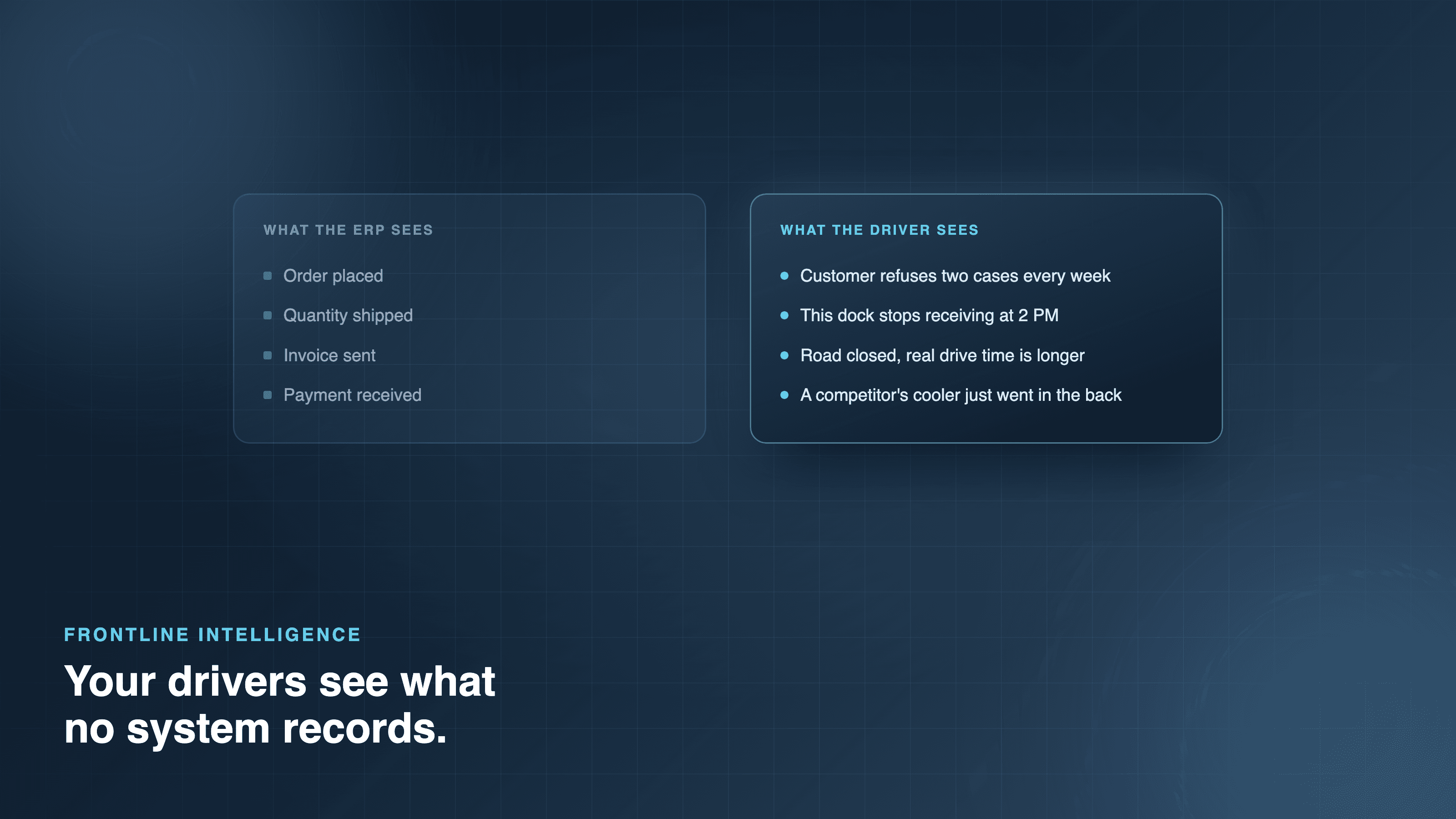
Your delivery drivers know things about your business that your ERP will never contain. They know which customer quietly refuses part of the order every week, which dock stops receiving at 2 in the afternoon no matter what the schedule says, which road has been closed for a month, and which account just had a competitor's cooler wheeled into the back. None of that is in a system, because no system was ever set up to catch it. The driver is the only person who sees the business at ground level every single day, and almost nobody asks them what they saw.
The intelligence that never reaches the system
An ERP records what was ordered, what shipped, and what was invoiced. It is a record of transactions, and it is good at that. What it does not record is the context around the transaction, the reality at the loading dock and the customer's back door. That context is exactly what determines whether the next delivery goes smoothly, whether the account is healthy, and whether the route is planned around how the world actually works. Drivers collect that context continuously, for free, and it evaporates at the end of every shift because there is nowhere for it to go.
What drivers actually see
The examples are specific, and every operator recognizes them. A customer who takes the delivery but sends back two cases every week is not a rounding error, it is a signal that something is wrong with how that account orders, and it usually shows up at the dock long before it shows up in the numbers. A dock manager who only receives until 2 PM is a routing fact that decides whether tomorrow's truck waits an hour or gets turned away. A road closed for construction changes the real drive time on a lane that route software still thinks is open. A competitor's cooler newly installed at a restaurant is the first warning that an account is being courted, weeks before the orders start to shrink. Each of these is visible to the driver and invisible to everyone back at the branch. The account-level version of this blind spot is the same one behind why 15 to 25 percent of distribution routes run at a loss: the cost and the risk are real, but nobody can see them from the office.
Why none of it reaches the ERP
There are three honest reasons this knowledge stays trapped, and none of them is that the driver does not care. The first is that there is no tool. A driver is not going to log into an ERP and type a paragraph after a ten-hour shift, and expecting them to is why every past attempt failed. The second is that there is no process. Nobody ever told them where this information should go, so it goes into their own head and stays there. The third is that there is no habit, because the first two were never solved, so noticing and reporting was never part of the job. Fix the tool and the process, and the habit follows. Leave them broken, and the best field intelligence in the company keeps walking out the door at the end of each day.
Three fields and thirty seconds
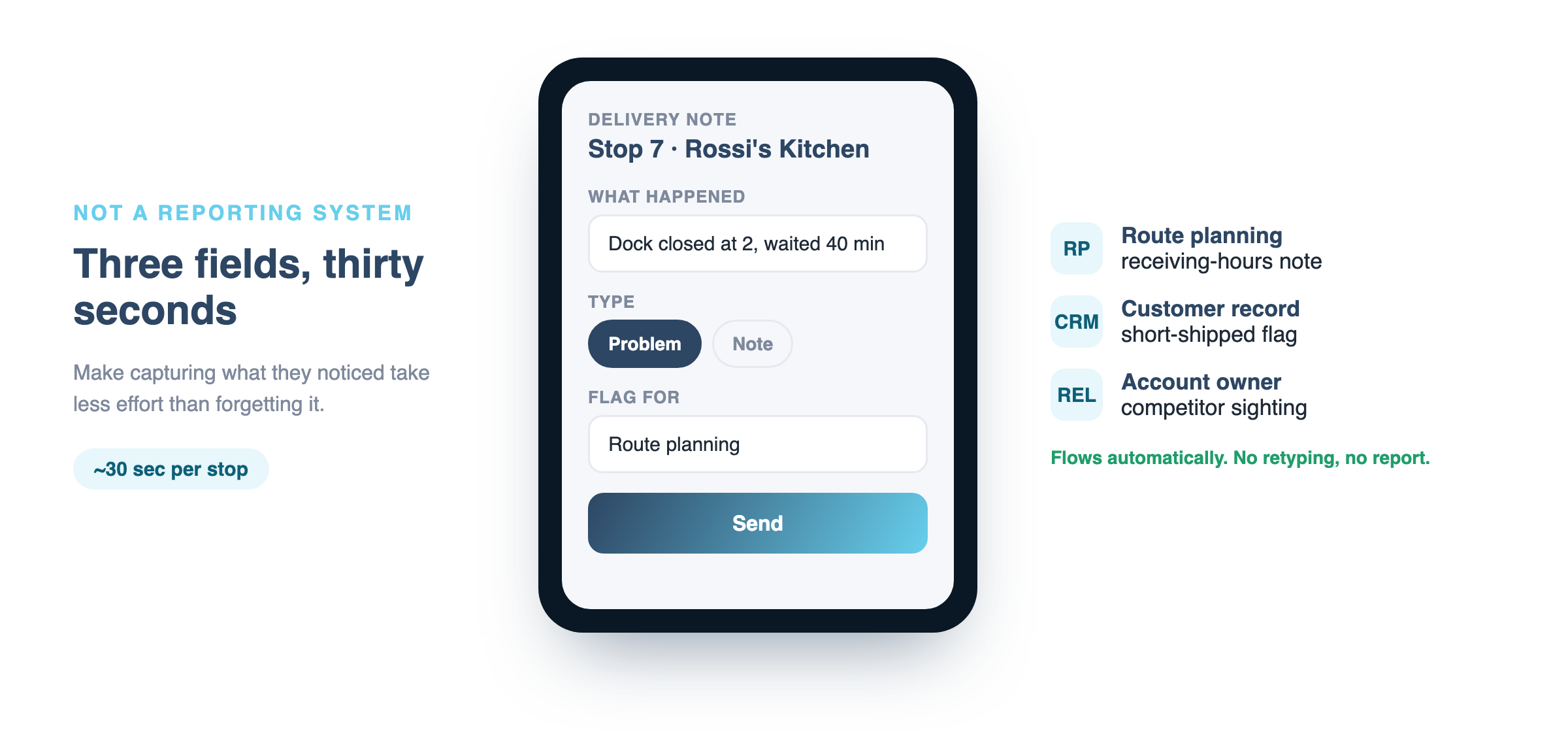
The fix is deliberately small. Not a reporting system, not a new responsibility, just a simple note the driver can make at the stop in about thirty seconds: a few fields on a phone, a tap or two and a short line of text. What happened here, was it a problem or an observation, and anything worth flagging. That is it. The point is to make capturing what they already noticed take less effort than forgetting it. Those notes then flow automatically to where they matter, the observation about receiving hours into route planning, the short-shipped account into the CRM against that customer, the competitor sighting to whoever owns the relationship. No retyping, no separate report, no meeting. This is the same idea behind putting the numbers where people can act on them that we covered in what a branch manager's day looks like without Excel, applied to the one person who sees the customer in the flesh.
The feedback loop is the whole point
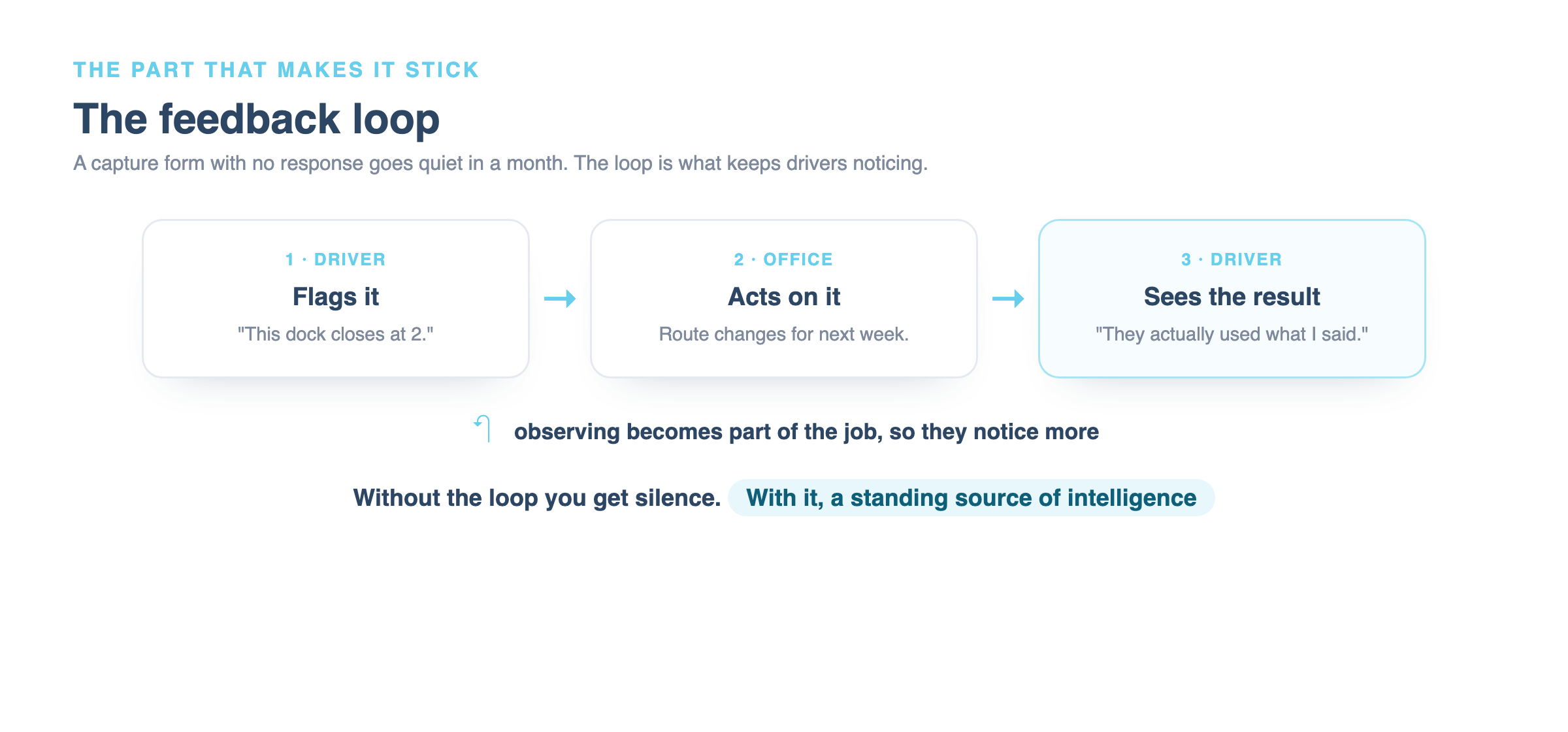
A capture form on its own dies in a month, because people stop feeding a box that never gives anything back. The part that makes it stick is the loop. When a driver flags that a dock closes early and the route actually changes the next week, they learn that saying something matters. When they note that an account keeps refusing product and someone from the office follows up, they see their observation turn into an action. That loop is what converts a one-time survey into a standing source of intelligence, because the driver has evidence that being observant is part of the job now, not extra work that disappears. Without the loop, you get silence. With it, you get people who start noticing more because it counts.
From box mover to part of the team
There is a human side to this that matters as much as the operational one. A driver treated as someone who moves boxes will move boxes. The same driver, asked what they see and shown that it changes decisions, becomes part of the team that runs the business. That shift is not sentimental, it is practical: the people at the edge of the operation are the ones who spot problems first, and a company that listens to them finds out about a struggling account or a broken lane weeks earlier than one that does not. The intelligence was always being gathered. The only question is whether the business chooses to receive it, an approach we build into the operating picture rather than bolting on, as in our unified operational dashboard case.
Frequently asked questions
What do delivery drivers know that an ERP does not capture?
Ground-level context around each stop: a customer who relocated, a dock that only receives until a certain hour, a road closed for construction, a competitor's cooler newly placed at an account, or a customer who routinely refuses part of an order. An ERP records what was ordered, shipped, and invoiced, but not the real conditions at the customer's door that decide whether the next delivery and the next order go well.
Why does driver knowledge never make it into the system?
Three reasons: there is no tool, since a driver will not type a report into an ERP after a long shift; there is no process telling them where the information should go; and there is no habit, because the first two were never solved. Fix the tool and the process and the habit forms. Left unsolved, the knowledge stays in the driver's head and leaves with them at the end of the day.
How do you actually capture what drivers see?
With a simple mobile note of a few fields that takes about thirty seconds at the stop, not a reporting system. What happened, whether it is a problem or an observation, and anything worth flagging. Those notes flow automatically into route planning and the CRM against the right customer, so nothing has to be retyped and no separate report is needed.
Why is a feedback loop important for driver reporting?
Because people stop feeding a system that never responds. When a driver sees a flagged dock time actually change a route, or a short-shipped account get followed up, they learn that observing matters and keep doing it. Without that visible loop, a capture form goes quiet within weeks. With it, drivers begin noticing more because it clearly counts.
Is this worth it for a smaller distributor?
Often more so, because a smaller distributor lives or dies on account relationships and route efficiency, and it usually has fewer people watching each account from the office. The drivers are already collecting the intelligence at no extra cost. Capturing even a fraction of it earlier warning on a shaky account or a broken lane tends to pay for a very light tool quickly.
When did you last ask your drivers what they see out there
Your ERP will tell you what you sold. It will not tell you that a good account just got a competitor's cooler in the back, or that tomorrow's delivery is going to sit at a dock that closed an hour before the truck arrives. The people who know those things are already on your payroll and already see them every day. The only question is whether the business gives them a thirty-second way to say it and then shows them it mattered. 3ALICA builds that kind of capture into the route and customer systems a distributor already runs, so field intelligence becomes something the business can act on instead of something that leaves at the end of each shift.
Turning what the fleet knows into something leadership can act on is our logistics work.