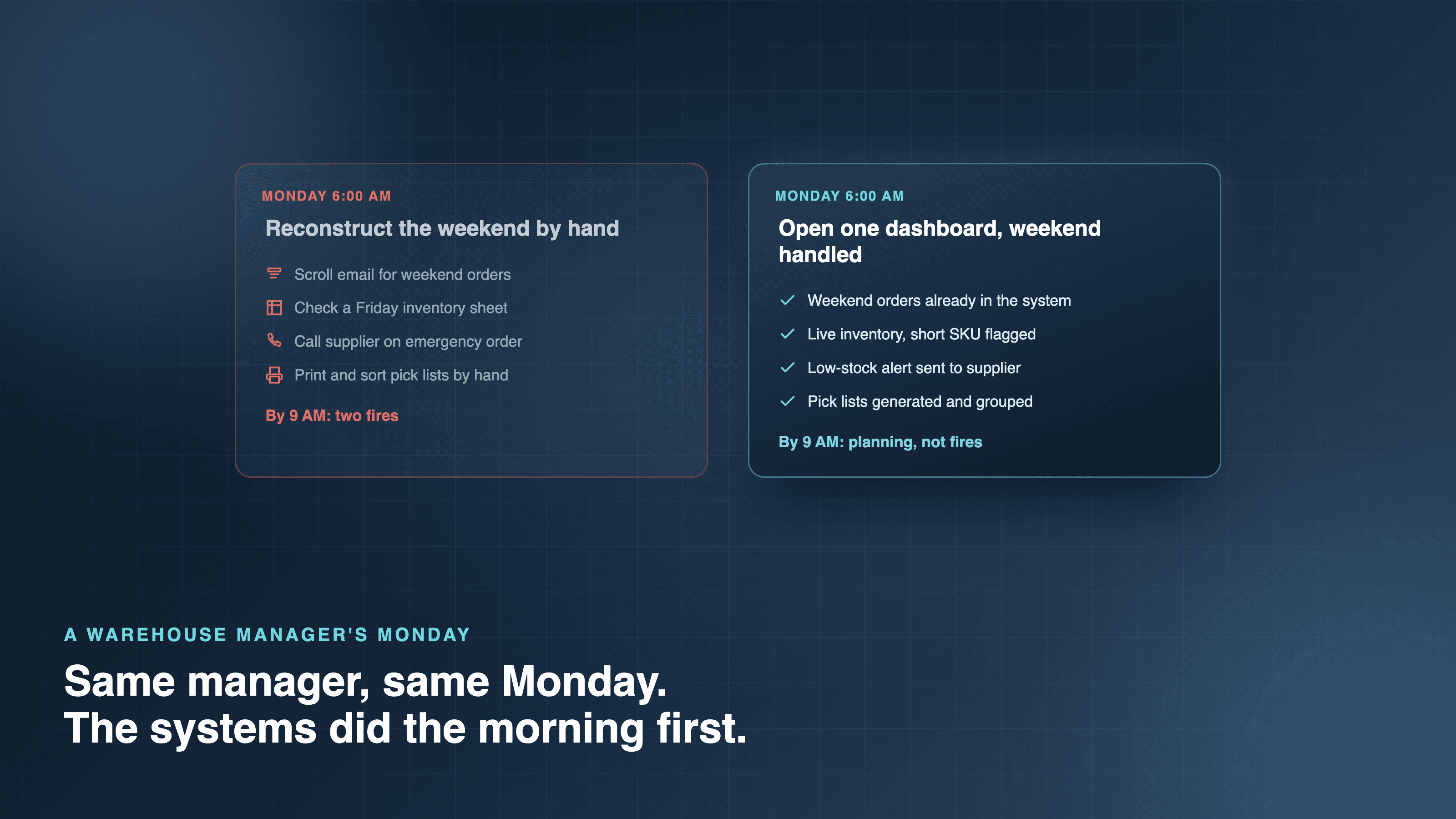
With real-time visibility, a warehouse manager's Monday starts with a dashboard that already knows what happened over the weekend instead of a morning spent reconstructing it by hand. The weekend orders are in the system, inventory status is current, pick lists are generated, and low-stock alerts have already gone to suppliers. The difference is not a busier morning or a quieter one. It is the difference between spending the first three hours fire-fighting and spending them planning. Here is the same Monday, told twice.
This is a composite scenario, not a case study. It reflects patterns common across distribution and manufacturing warehouses, not one real customer.
Before: 6 AM, and the day is already behind
He gets in at six because Monday is the worst day and an early start is the only defense. First the email, scrolling for the weekend orders that came in after Friday, copying the important ones somewhere he will remember them. Then the inventory spreadsheet, the one that was accurate on Friday afternoon and is now a day and a half stale, checked line by line against what he thinks actually shipped. Somewhere in there he finds a SKU that is short for a job going out this morning, so he calls the supplier about an emergency order and starts the negotiation over rush freight. Then the pick lists, printed and sorted by hand, because the system will not group them the way the floor actually works.
By nine, two things have already gone wrong. A truck is waiting on the short SKU he caught too late, and a second order turns out to have been picked against inventory that was not really there. The morning he planned to spend getting ahead is gone, spent instead on the two fires that the manual start of the day guaranteed he would not see coming.
After: 6 AM, and the weekend is already handled
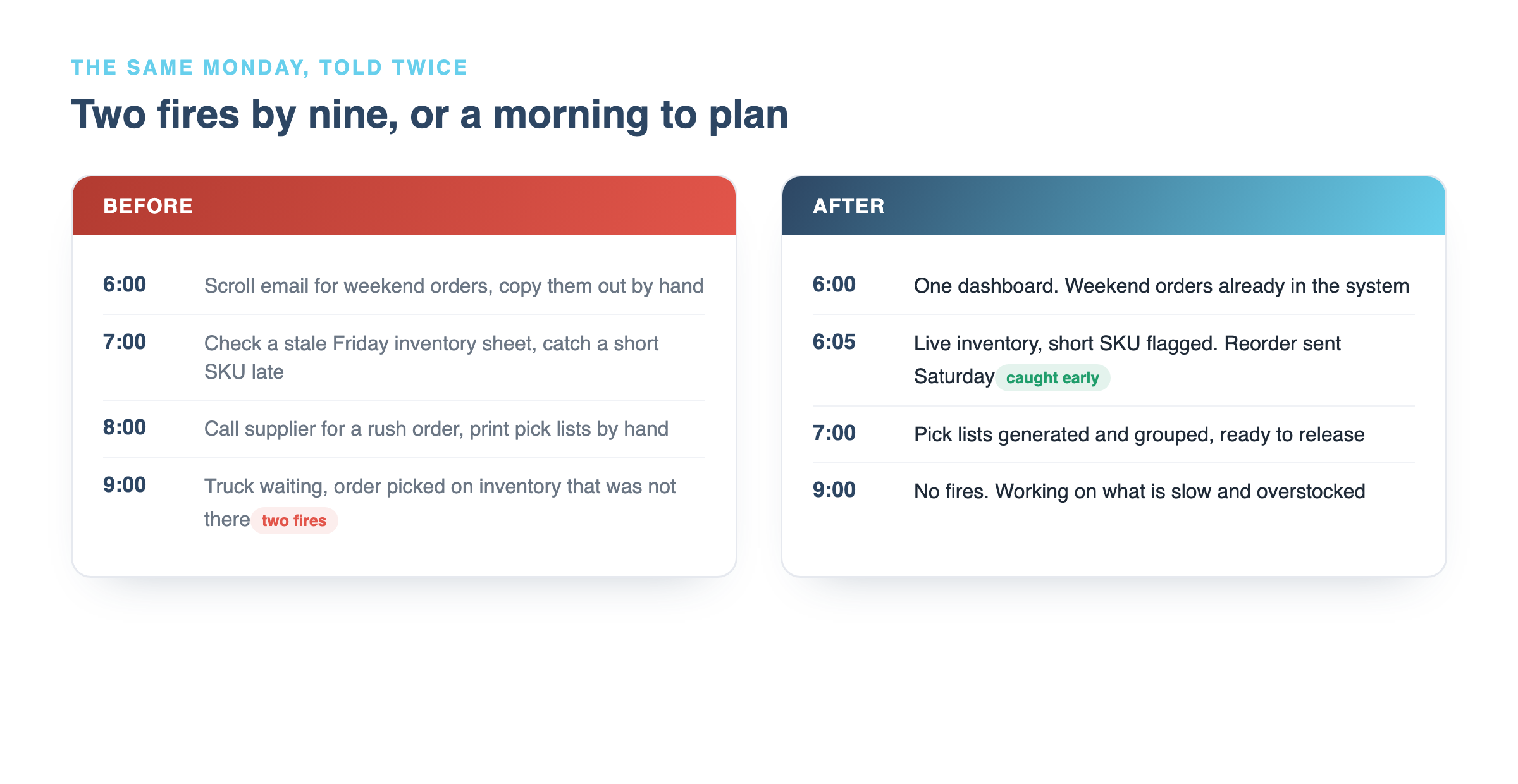
The same manager, the same Monday, after a visibility and automation layer went in. He gets in at six out of habit, opens one dashboard, and the weekend is already accounted for. Orders that came in Saturday and Sunday are in the system, not in his inbox. Inventory status is live, not a Friday snapshot, so the SKU that is running short is flagged on the screen rather than discovered at the loading dock. The low-stock alert on that SKU went to the supplier automatically over the weekend, so the reorder is already moving before he sits down. The pick lists are generated and grouped the way the floor runs, waiting to be released rather than assembled by hand.
By nine, there are no fires, because the two that would have started were caught while they were still just numbers on a screen. The short SKU was reordered Saturday. The bad inventory count never happened, because the count was current. What he does with the morning instead is the actual point.
The three shifts that change the morning
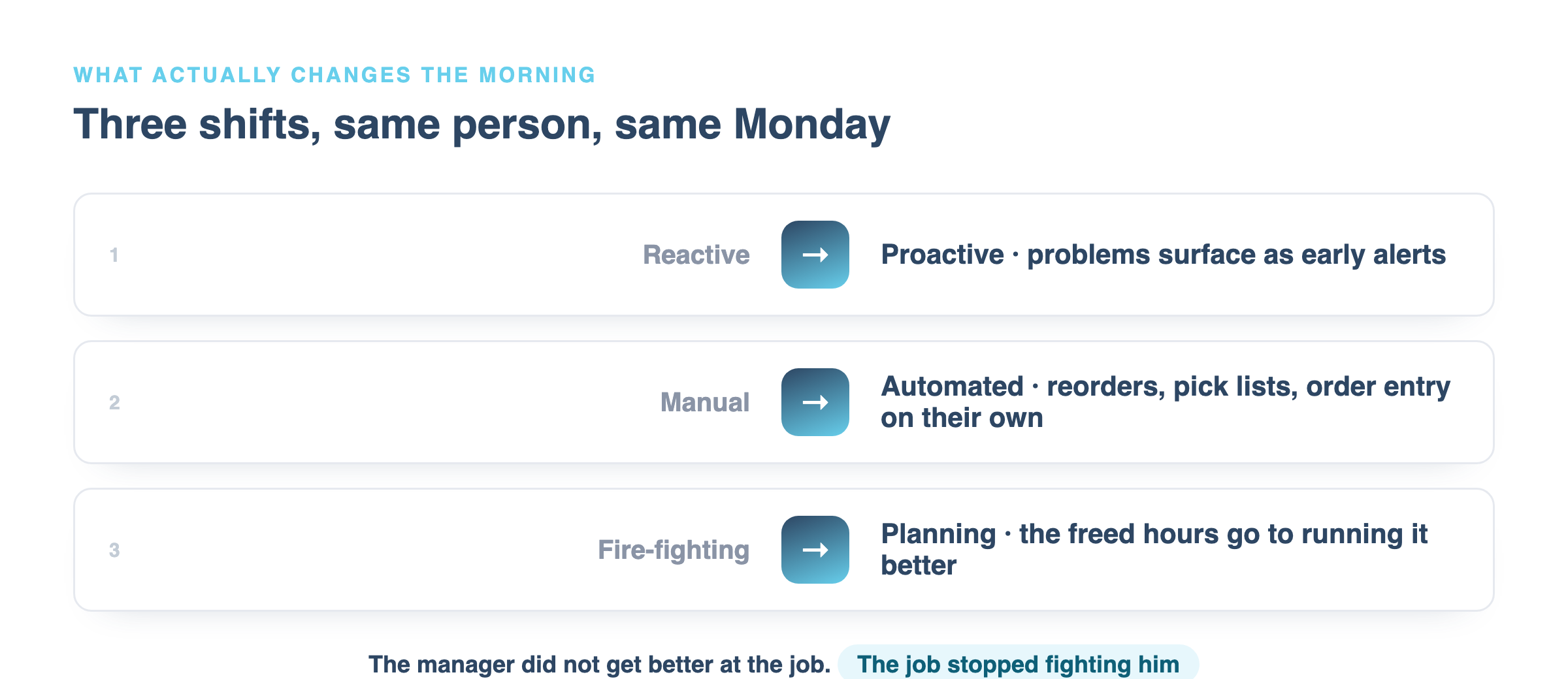
Underneath the story are three changes, and they are the whole difference. The first is reactive to proactive: the problems that used to reveal themselves at the dock now show up as alerts hours or days earlier, while there is still time to act. The second is manual to automated: the reorder alert, the pick list, the order entry that used to eat the first hours of the day now happen on their own, correctly, without him touching them. The third is fire-fighting to planning: with the crises defused before they start, the morning that was spent reacting is free for the work a manager is actually there to do, looking at what is slow, what is overstocked, and what could run better. This is the same shift from assembling data to acting on it that we described in what a branch manager's day looks like without Excel, seen from the warehouse floor rather than the office.
Why the mornings were different
Nothing about the second manager is smarter or more disciplined than the first. It is the same person on the same Monday. The only thing that changed is what the systems did before he arrived. In the first version, the data sat in email and a spreadsheet and waited for him to assemble it, which meant every problem was found late, by hand, under time pressure. In the second, the data was already connected and watching itself, so the routine work was done and the exceptions were surfaced early. The manager did not get better at his job. The job stopped fighting him. The visibility and automation ran on the WMS and ERP the warehouse already had, the same connect-what-exists approach behind our unified operational dashboard case, rather than a new system to learn.
From dreading Monday to just another day
The human change is the one that lasts. A manager who spends every Monday morning fire-fighting comes to dread the day, and that dread is not weakness, it is a rational response to a morning designed to ambush him. Take the ambush away and Monday becomes ordinary. The same hours that went to panic go to planning, the part of the job that actually moves the warehouse forward and the part he was hired for. He used to arrive braced for the fires. Now Monday is just another day, which is exactly what a well-run Monday should feel like.
Frequently asked questions
Is this a real warehouse manager's story?
No. It is a composite scenario built from patterns common across distribution and manufacturing warehouses, written to show a typical Monday before and after visibility and automation. It is not based on a single real customer, and the details are illustrative rather than a specific account.
What actually changes a warehouse manager's morning?
Three shifts. Reactive to proactive, where problems surface as early alerts instead of dock-side surprises. Manual to automated, where reorder alerts, pick lists, and order entry happen on their own. And fire-fighting to planning, where the hours freed from crises go to improving how the warehouse runs. Together they turn a morning of reconstruction into a morning of decisions.
What does real-time inventory visibility actually do on a Monday?
It replaces a stale Friday spreadsheet with a live view, so a short SKU is flagged on screen at 6 AM rather than found at the loading dock at 9. That timing is the whole value: caught early, it is a reorder; caught late, it is a waiting truck and a missed job. Live inventory also prevents picking against counts that are no longer true.
Do you have to replace the WMS or ERP to get this?
No. The visibility and automation layer is built on top of the WMS and ERP the warehouse already runs, reading the data those systems already hold and acting on it. Nothing is ripped out and no migration is required. The point is to make the existing systems work together and watch themselves, not to start over.
How do automated supplier alerts work?
When inventory for a SKU crosses a defined threshold, the system sends a low-stock alert to the right supplier automatically, including over the weekend, so a reorder can begin before anyone is at their desk on Monday. It turns replenishment from something a manager remembers to do into something that happens on its own, which is what keeps the Monday short-SKU crisis from starting in the first place.
What would your Monday look like with better visibility
The warehouse manager in this story is a composite, but the Monday is not unusual. An early start, an inbox of weekend orders, a stale spreadsheet, and two fires by nine is the normal cost of running a warehouse on systems that wait to be assembled by hand. The fix is not a new WMS. It is a layer that connects the systems already there so the routine is handled and the exceptions surface early, turning the first hours of the week from fire-fighting into planning. 3ALICA builds that visibility and automation on the systems a warehouse already runs.
That Monday view is the Operational KPI Sprint, built around the systems you already have.