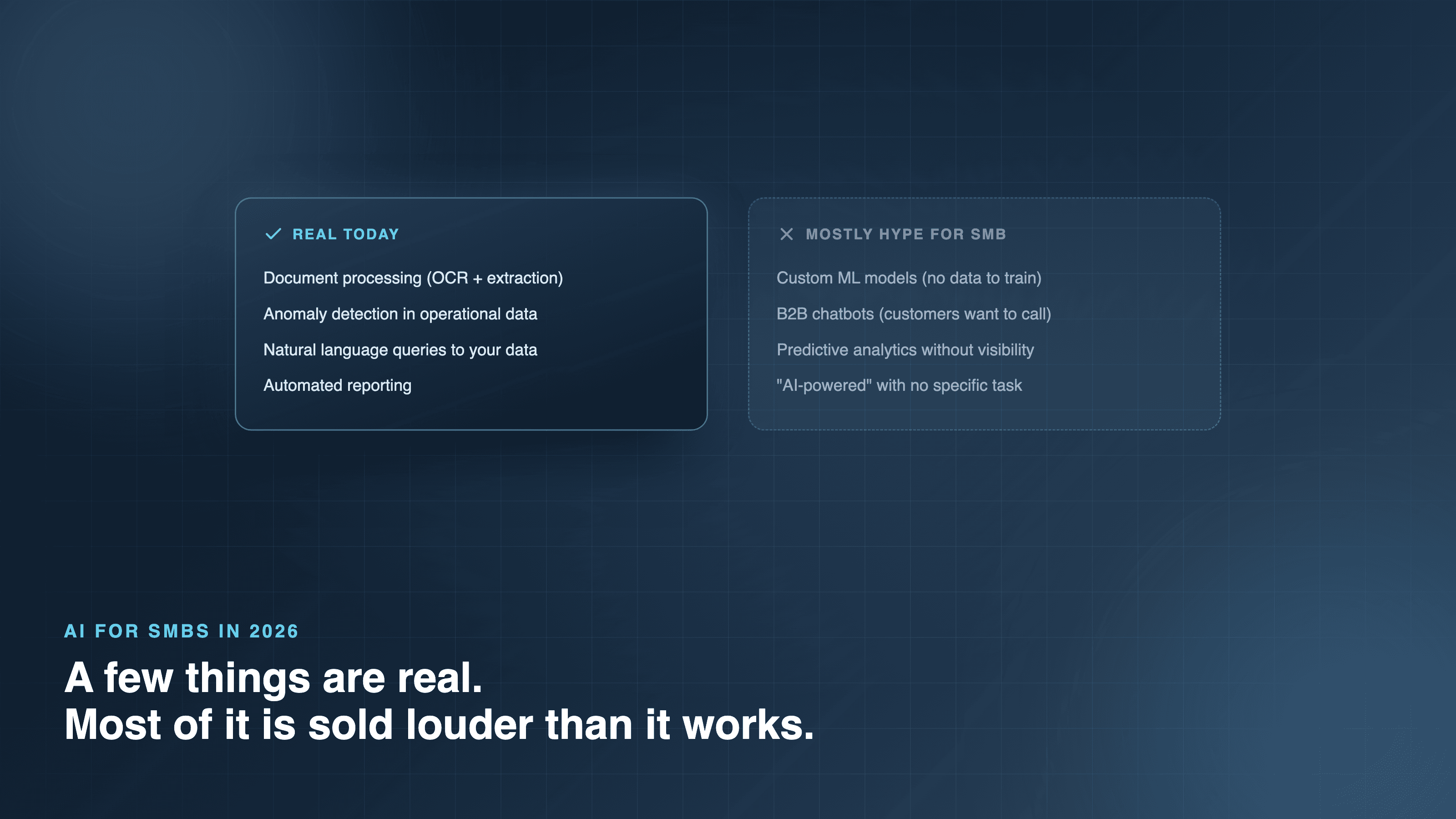
For a mid-sized business in 2026, AI is being sold by everyone, and only a handful of uses reliably pay off. The honest answer to what AI can actually do for an established company running on the systems it already has is narrow and practical: it can read documents, spot anomalies in your data, answer plain-language questions about your numbers, and generate reports. Most of the rest of what gets pitched, custom models, B2B chatbots, predictive analytics on data you cannot yet see, either does not work at your scale or is not what you needed. Knowing the difference is worth real money, because the hype is priced accordingly.
What actually works for an SMB right now
Four uses are genuinely ready and deliver value at mid-market scale today. Document processing is the clearest win: optical character recognition plus data extraction turns purchase orders, invoices, and packing slips into structured data without anyone re-keying them. Anomaly detection is the second, watching operational data and flagging the order, price, or count that does not fit the pattern, which is useful precisely because a person cannot watch every row. The third is natural language queries, letting someone ask a database a question in plain English instead of waiting on a report request. The fourth is automated reporting, where the weekly numbers assemble and distribute themselves. None of these are futuristic. They work now, on the data a business already has, and each solves a specific, boring, expensive problem.
What does not work, or is not needed
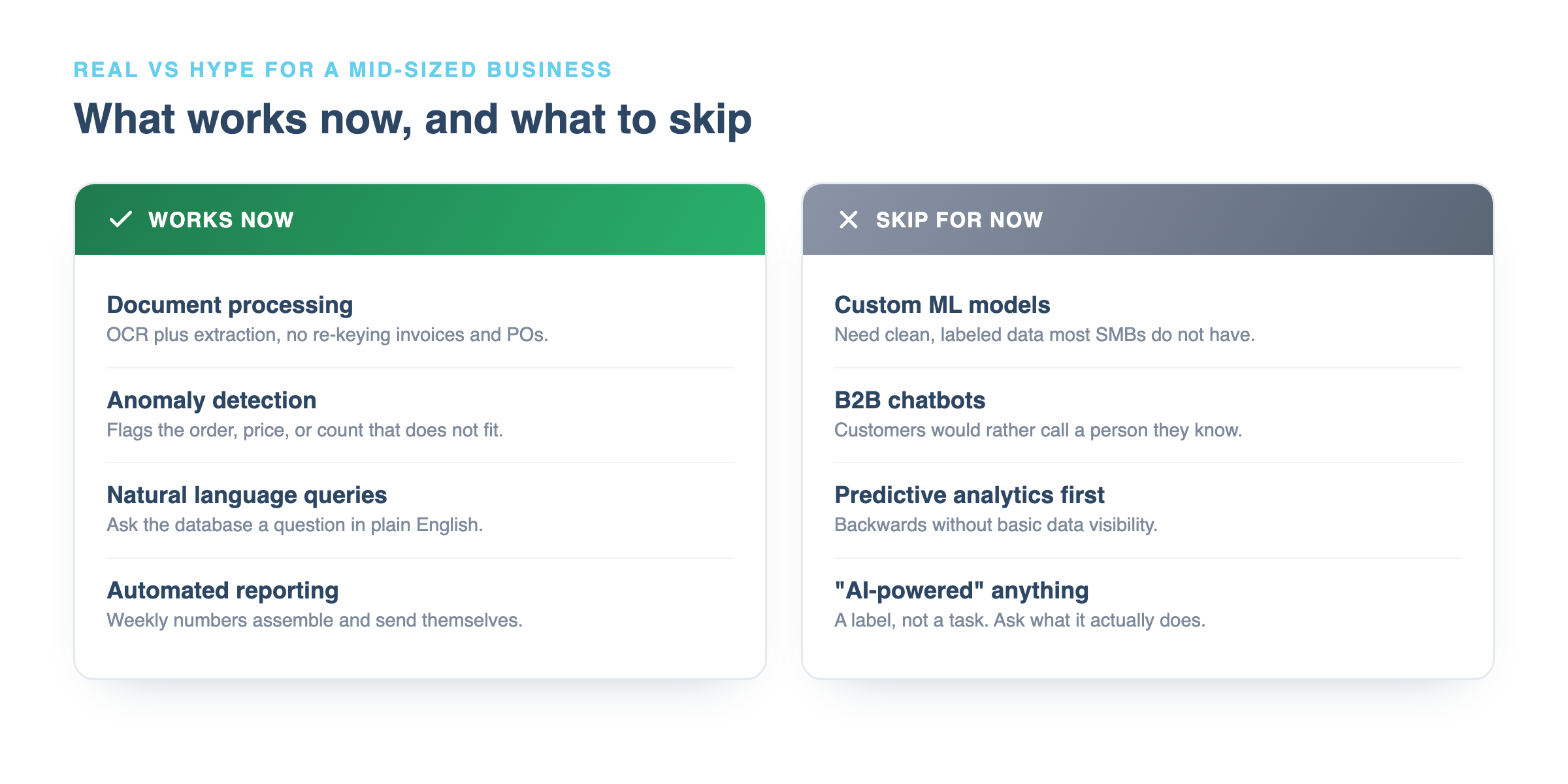
An equal amount of what gets sold does not fit a mid-sized operator, and it helps to name it. Custom machine learning models are the classic trap: they need large volumes of clean, labeled historical data to train on, and most SMBs do not have that, so the model learns from noise. B2B chatbots are oversold too, because in a lot of distribution and manufacturing relationships the customer wants to call a person they know, and a bot sits between them and that person. And predictive analytics sold on top of a business that cannot yet see its own current numbers is backwards, which is the whole argument in why SMBs should start with visibility before AI and prediction. The pattern is consistent: the pitch skips the unglamorous foundation and sells the exciting layer that only works once the foundation exists.
The vendor red flags
A few phrases in a sales conversation should make you slow down. "AI-powered" with no explanation of what the AI actually does is a marketing label, not a capability, and a vendor who cannot describe the specific task in plain terms usually does not have one. "Proprietary algorithm" used as a reason not to explain how something works is the same move in fancier clothes. A six-figure implementation fee before anything has been proven on your data is a bet you are being asked to fund. And "you need to migrate all your data first" is the biggest one, because it turns a point solution into a multi-year project and quietly moves the risk onto you. None of these guarantee a bad product, but each is a reason to ask harder questions before signing.
A four-question test for any AI pitch
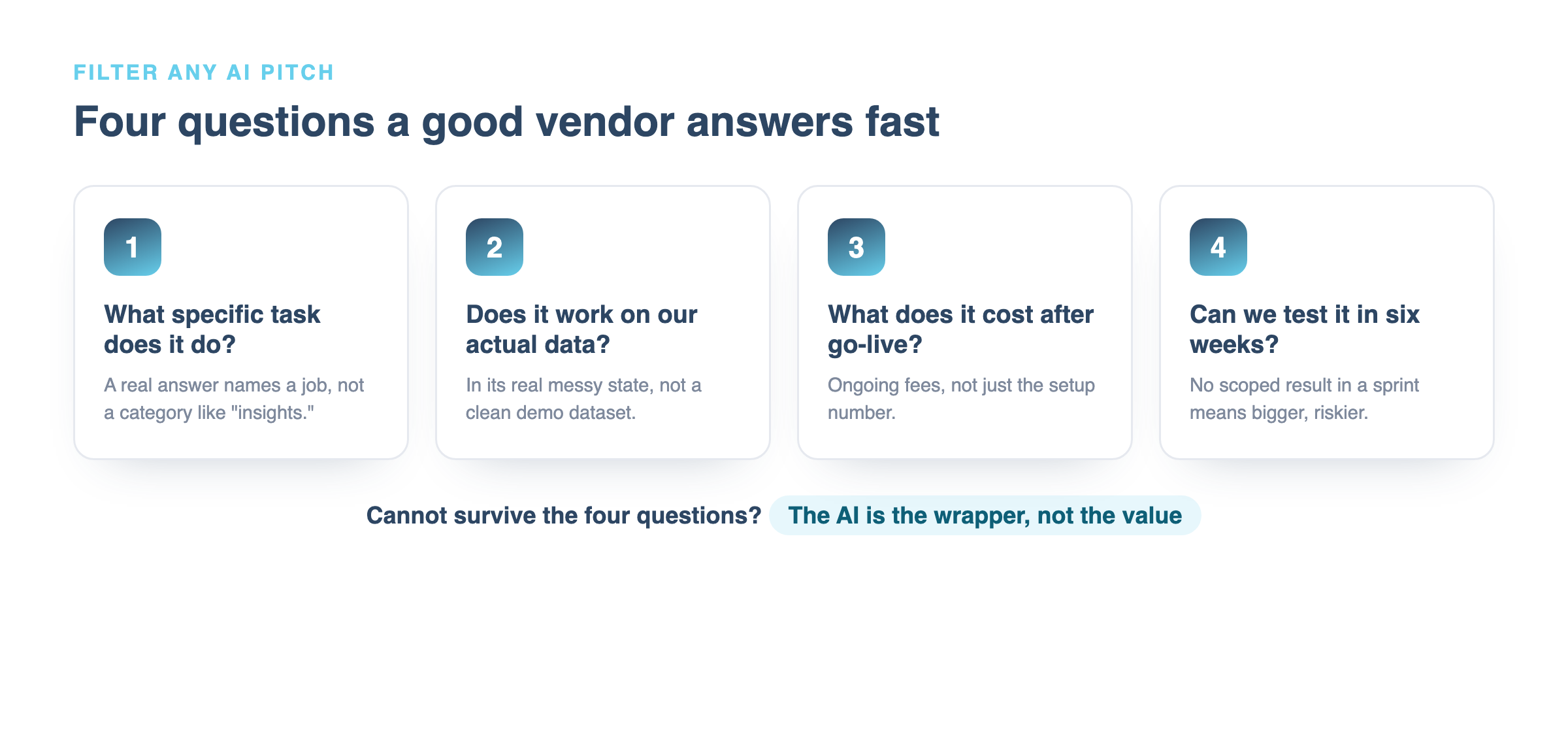
You can filter most of the noise with four questions, and a good vendor answers all of them quickly. What specific task does this do? A real answer names a job, not a category. Does it work on our actual data, in the state it is actually in? A demo on a clean sample dataset proves nothing about your messy reality. What does it cost after implementation, including the ongoing fees, not just the setup? The number that matters is the running cost once it is live. And can we test it in about six weeks? If a genuine, scoped result is not possible in a short sprint, the project is bigger and riskier than it is being made to sound, and the same sprint-first logic applies here as in the rest of operational tech, covered in what a branch manager's day looks like without Excel. If a pitch cannot survive these four questions, the AI is probably the wrapper, not the value.
How we actually use AI
Our own position is deliberately unfashionable: we use AI to deliver work faster and cheaper, and we do not sell AI as the product. That distinction matters for a buyer. When AI is the product, the incentive is to make it sound bigger than it is. When AI is a tool inside a delivery method, the incentive is to use it only where it genuinely speeds up a real result, like extracting data from documents or flagging anomalies inside a build, and to leave it out where it does not help. The value a business should pay for is the solved problem, delivered in weeks on the systems it already runs, as in our operational visibility work and our AI-assisted automation in manufacturing. The AI is how the work gets done, not the thing being sold.
Frequently asked questions
What AI actually works for a small or mid-sized business in 2026?
Four uses are reliably ready at mid-market scale: document processing (OCR plus data extraction), anomaly detection in operational data, natural language queries to databases, and automated reporting. Each solves a specific, recurring, expensive problem and runs on the data a business already has. Most other AI pitches either do not fit an SMB or depend on a data foundation that is not in place yet.
What AI should an SMB avoid buying?
Custom machine learning models when you lack the clean historical data to train them, B2B chatbots when your customers would rather call a person they know, and predictive analytics sold on top of a business that cannot yet see its current numbers. These fail not because the technology is fake but because the prerequisites are missing, so the spend produces confident but unreliable output.
What are the warning signs of an AI vendor overselling?
Four common ones: "AI-powered" with no explanation of the specific task, "proprietary algorithm" used to avoid explaining how it works, a six-figure implementation fee before anything is proven on your data, and a requirement to migrate all your data before you see value. None prove a bad product, but each is a reason to ask sharper questions and to insist on a small, real test first.
How should I evaluate an AI tool for my business?
Ask four questions. What specific task does it do? Does it work on our actual data in its current messy state, not a clean demo? What does it cost after implementation, including ongoing fees? And can we prove it in about six weeks? A capable vendor answers all four quickly. If a pitch cannot survive them, the AI is likely the marketing wrapper rather than the value.
Does my business need AI to stay competitive?
Not as a product to buy, but the practical uses that save time and money are worth adopting where they fit. The better framing is to solve a specific operational problem and use AI only where it genuinely makes that faster or cheaper, rather than buying AI as a strategy. Start from the problem and the data you have, not from the technology.
Want a reality check
AI in 2026 is real in a few specific places and oversold almost everywhere else, and for a mid-sized business the cost of confusing the two is measured in six-figure implementations that never deliver. The useful move is not to buy AI or to avoid it, but to separate the handful of uses that work on your actual data from the pitch built to sound impressive. 3ALICA uses AI to deliver faster and cheaper rather than selling it as the product, and we are happy to help sort the real from the hype for your specific operation.
For what this looks like as a piece of work rather than a category: AI and automation, or the operations sprints if you would rather start from one bottleneck.