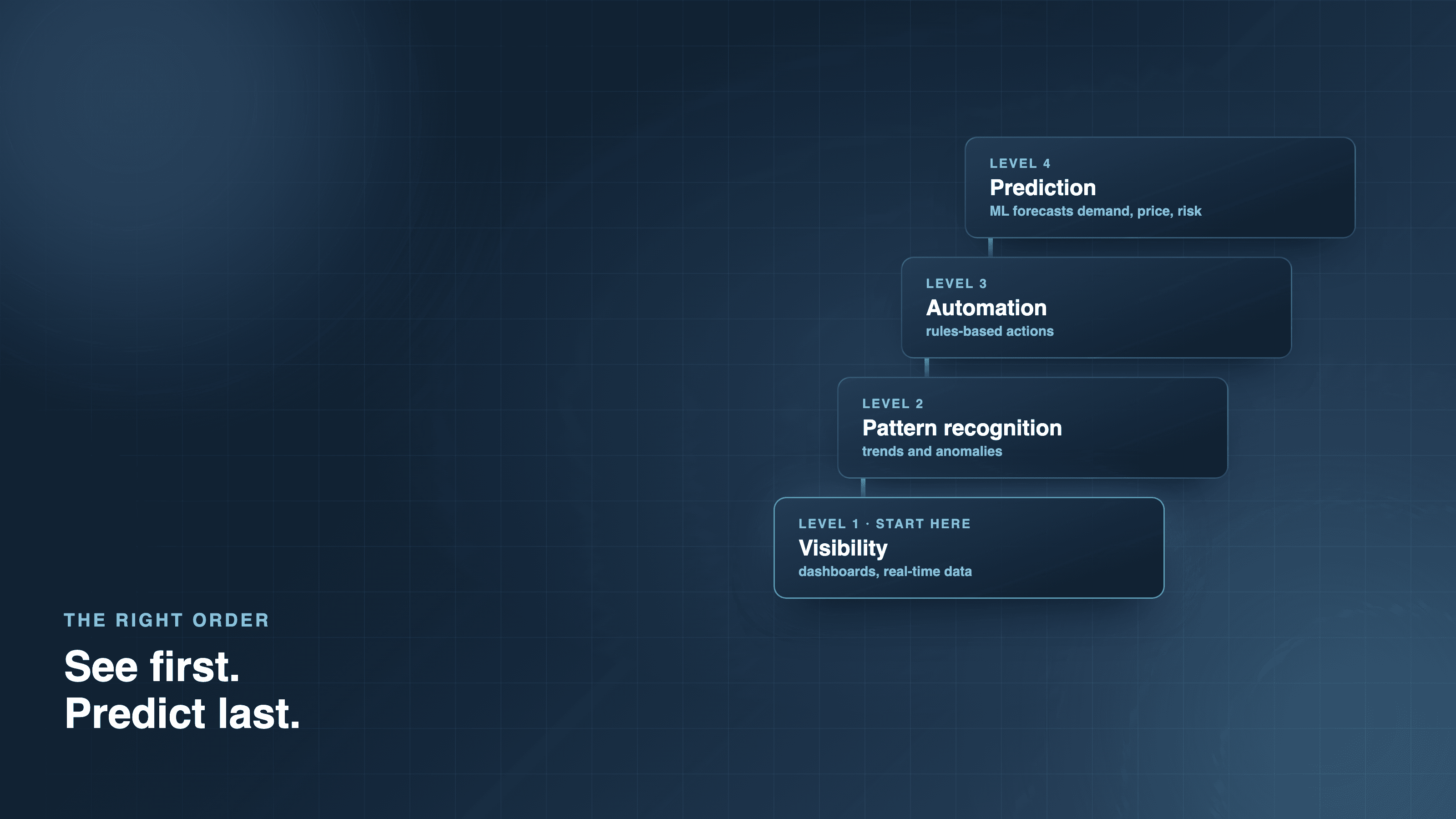
SMBs should start with visibility because a prediction model built on data you cannot yet see is the most common way to waste an operational tech budget. The reliable order is to see the data, understand the patterns in it, automate the routine decisions, and only then predict. That sequence is not a preference. Each layer depends on the one beneath it, and the AI at the top only works when the foundation under it is solid. Most small businesses asking for AI predictions are trying to build the top of the stack before the bottom exists.
The four levels of operational tech
It helps to think of operational tech as four levels, each built on the last. Level 1 is visibility: dashboards and real-time data that simply show what is happening in the business right now, in one place. Level 2 is pattern recognition: once the data is visible and clean, trends and anomalies become readable, so a slow-moving product line or an unusual spike stands out. Level 3 is automation: with patterns understood, routine decisions can be handled by rules, like a reorder that fires when stock crosses a threshold. Level 4 is prediction: machine learning models that forecast demand, price, or risk. Prediction is the impressive part, and it is also the part that fails first when the three levels beneath it are missing.
Why you cannot skip to prediction
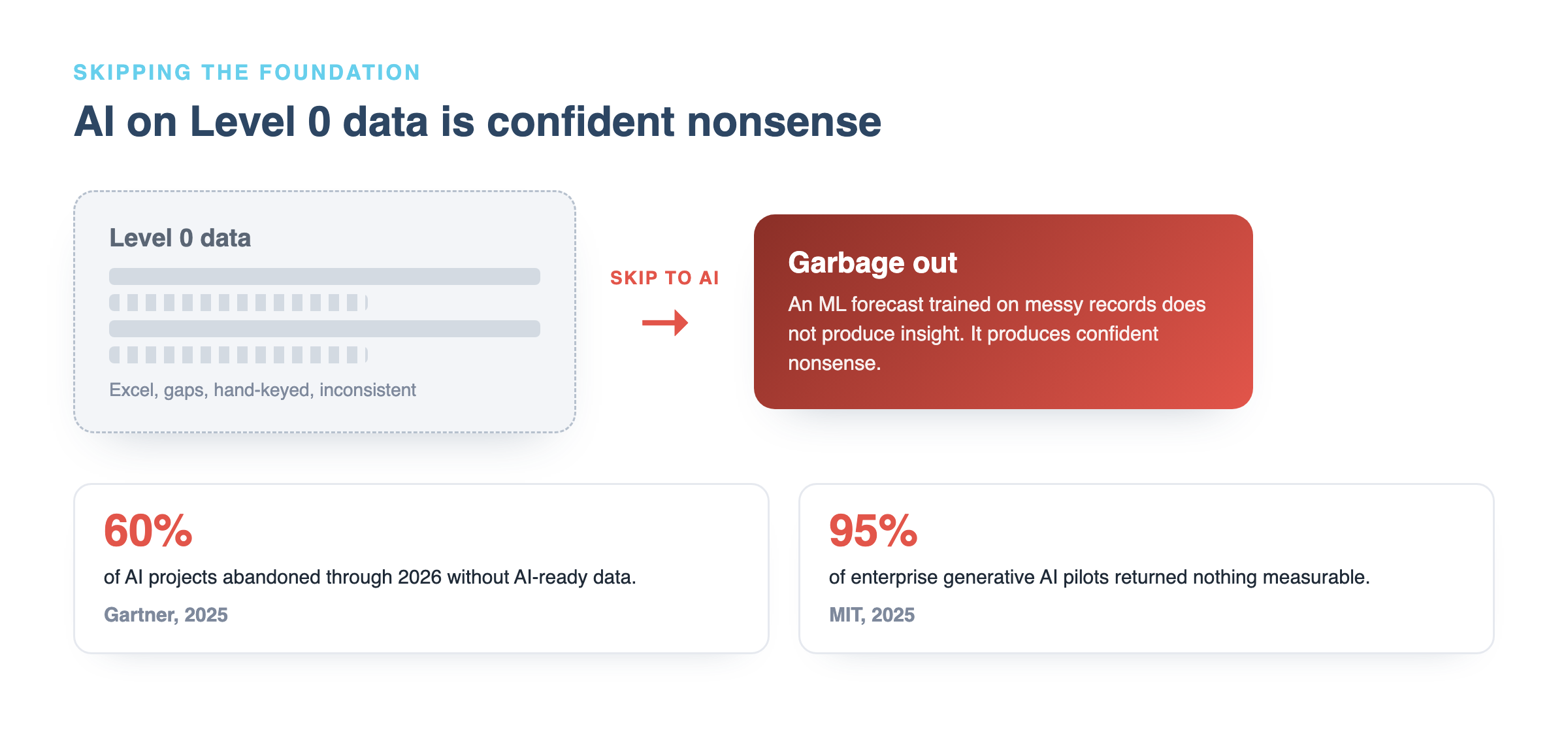
A model is only as good as the data it learns from, and most small businesses do not yet have data a model can learn from. This is garbage in, garbage out, in the small-business version: an ML forecast trained on incomplete inventory records and hand-keyed spreadsheets does not produce insight, it produces confident nonsense. The evidence at the enterprise level is blunt. Gartner predicted that through 2026, organizations would abandon 60 percent of AI projects unsupported by AI-ready data (Gartner, 2025). An MIT study of more than 300 initiatives found that 95 percent of enterprise generative AI pilots produced zero measurable return (MIT, 2025). If companies with real data teams stall on the data foundation, an SMB jumping straight to prediction is buying the same failure at a smaller scale. The fix is not a better model. It is the visibility layer the model needed in the first place.
Most SMBs are starting from Level 0
The uncomfortable truth is that most small and mid-sized operators are not at Level 1 yet. They are at Level 0: the business runs on Excel and manual processes, and the real numbers get assembled by hand when someone needs them. That is not a criticism, it is just where a lot of distribution, manufacturing, and food operators actually are. It also means the first real move is not AI, it is simply making the data visible. Reaching Level 1 is already a transformation, because it replaces a morning of reconciliation with a screen that is current, a shift we walked through in what a branch manager's day looks like without Excel. Skipping that step is why so many new systems get abandoned, the pattern behind why teams drift back to Excel after a launch.
The sprint order that works
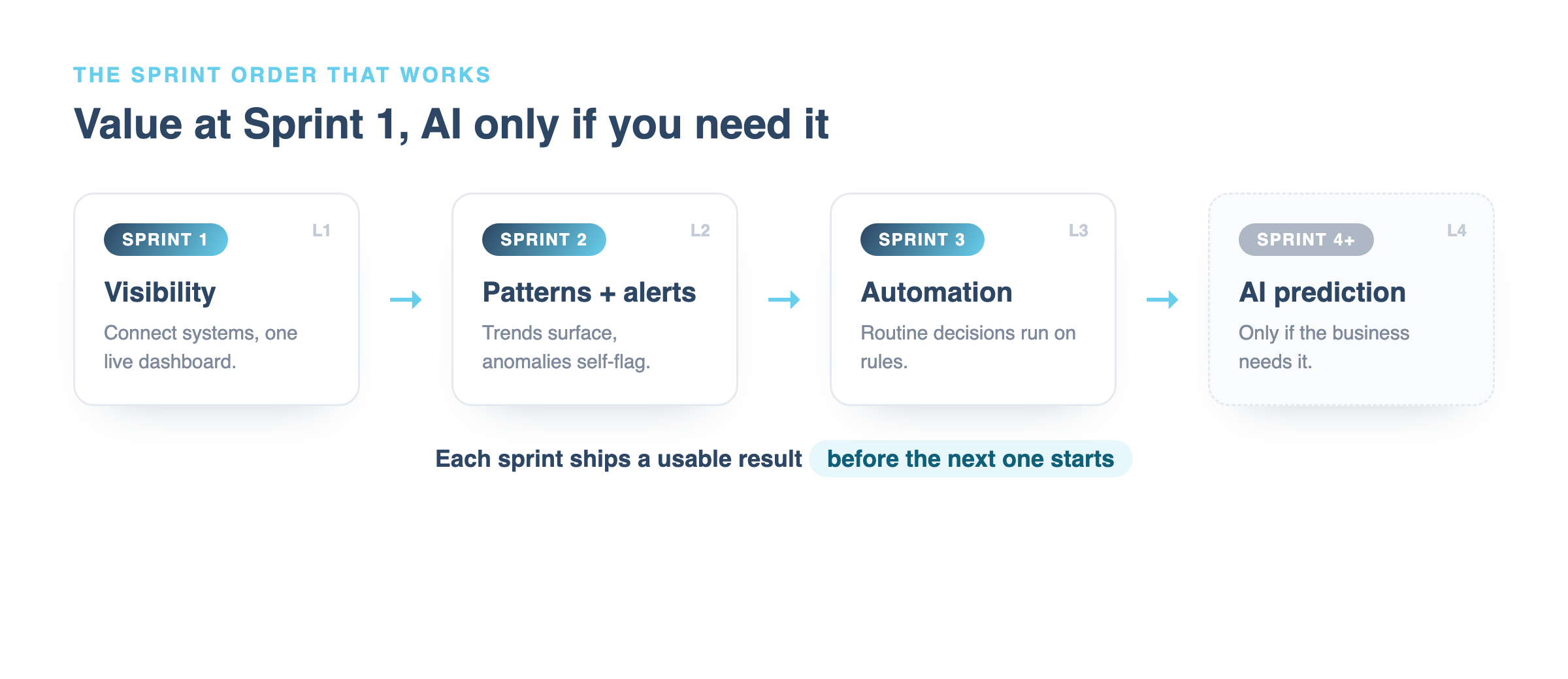
The sequence maps cleanly onto short sprints, which is how we build it. Sprint 1 is visibility: connect the systems that already hold the data and put it on one live dashboard. Sprint 2 is pattern recognition and alerts: now that the data is trustworthy, surface the trends and let the anomalies flag themselves. Sprint 3 is automation: turn the clearest, most repetitive decisions into rules that run on their own. AI prediction is Sprint 4 and beyond, and only if the business actually needs it. Plenty of operators find that Levels 1 through 3 solve the problem they came in with, and prediction turns out to be a nice-to-have rather than the point. Building in this order also fits how sprints beat long rollouts in the first place, which we covered in why most operations software takes 12 months to prove it was wrong.
AI when you are ready, not when a vendor is selling
There is a lot of pressure right now to buy AI first, because AI is what is being sold. The order that actually works runs the other way. Start with seeing, because you cannot manage or model what you cannot see. Add pattern recognition and automation as the data earns trust. Bring in AI when the foundation is ready to support it and the business has a real question only a model can answer, not because a demo looked impressive. That is the honest version of operational tech for an SMB: the value shows up at Level 1, compounds through Level 3, and AI is an option you grow into, not an entry fee. We build the visibility layer on the systems a company already runs, as in our unified operational dashboard case, and add higher levels only when they earn their place.
Frequently asked questions
What are the four levels of operational tech?
Level 1 is visibility, meaning dashboards and real-time data that show what is happening now. Level 2 is pattern recognition, where trends and anomalies in that data become readable. Level 3 is automation, where routine decisions run on rules. Level 4 is prediction, where machine learning models forecast demand, price, or risk. Each level depends on the one below it, so the value builds from the bottom up rather than the top down.
Why should an SMB not start with AI?
Because AI models trained on incomplete or messy data produce unreliable results, the small-business version of garbage in, garbage out. Gartner predicted organizations would abandon 60 percent of AI projects unsupported by AI-ready data through 2026, and an MIT study found 95 percent of enterprise generative AI pilots returned nothing measurable. If well-resourced companies fail this way, an SMB skipping the data foundation is buying the same outcome. Visibility first is what makes any later AI work.
What does visibility actually mean at Level 1?
It means the numbers that run the business, inventory, margin, orders, and cost, are visible in one place and current, instead of scattered across spreadsheets and assembled by hand. Practically, it is a live dashboard fed by the systems the business already uses. For most operators this alone replaces hours of manual reconciliation and is a meaningful change before any advanced analytics enter the picture.
How long does it take to get to each level?
Each level maps to a short sprint. Sprint 1 delivers visibility, Sprint 2 adds pattern recognition and alerts, and Sprint 3 adds rules-based automation. Prediction, if it is needed at all, is Sprint 4 and beyond. Working in sprints means each level produces a usable result on its own rather than waiting on a long, all-or-nothing rollout.
Does every business eventually need AI prediction?
No. Many operators find that visibility, pattern recognition, and automation solve the problem they came in with, and prediction is a nice-to-have rather than the goal. AI is worth adding when the foundation is solid and the business has a specific question only a model can answer. It should be a step a company grows into, not the reason the project starts.
Where are you on the visibility ladder
The fastest way to know what to build next is to find your current level. If the business still runs on spreadsheets and manual reconciliation, the highest-value move is not AI, it is visibility, and that is usually one sprint away. Pattern recognition, automation, and prediction follow in order as the data earns trust. 3ALICA starts with seeing, builds each level on the systems a company already runs, and brings in AI when a business is ready for it rather than when a vendor wants to sell it.
Sources
- Gartner, Lack of AI-Ready Data Puts AI Projects at Risk (through 2026, 60 percent of AI projects abandoned without AI-ready data), February 2025
- Fortune, MIT report: 95 percent of enterprise generative AI pilots are failing, August 2025
Visibility first is exactly what the Operational KPI Sprint delivers, in six weeks and without replacing your core systems.