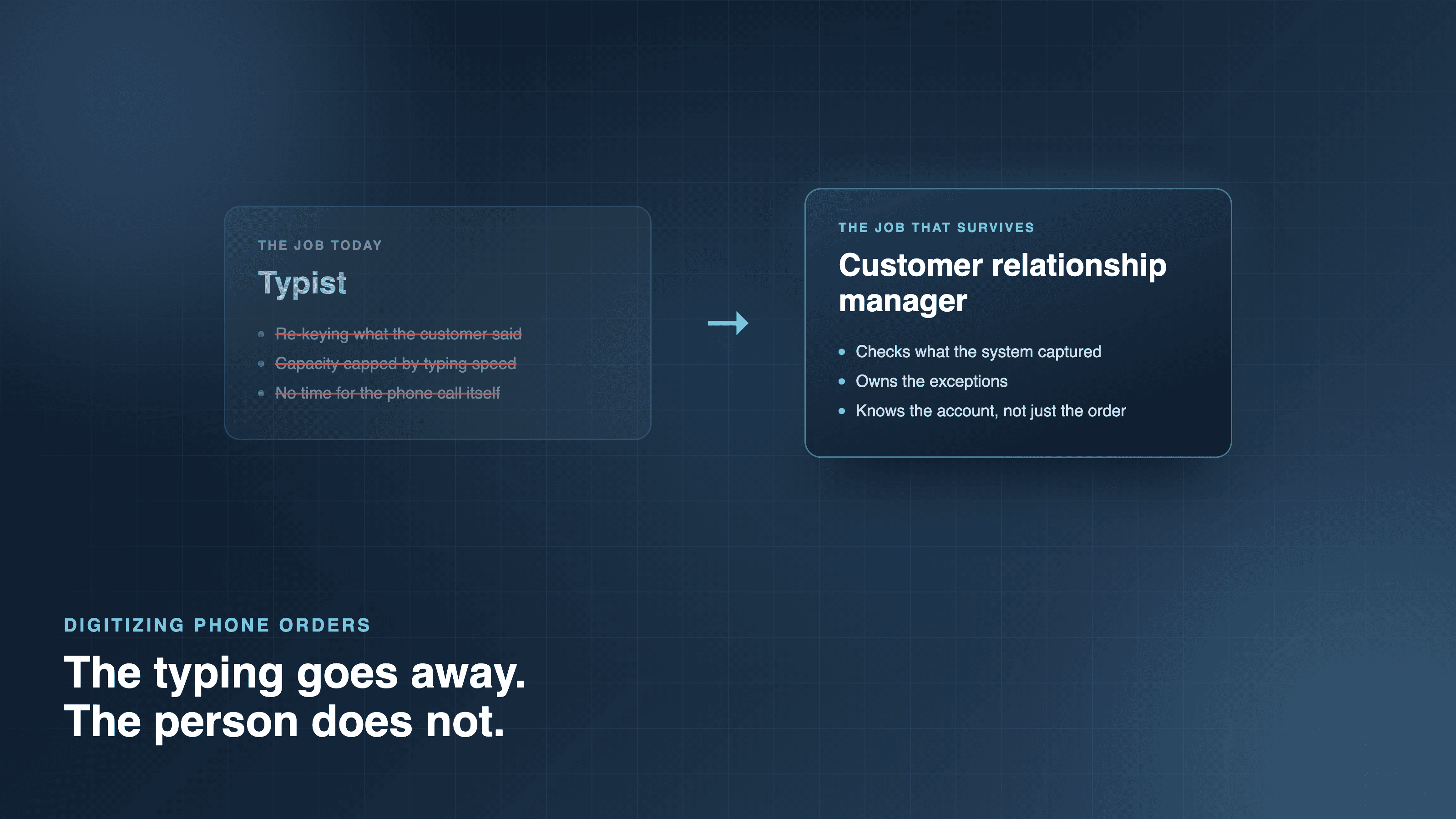
When phone orders get digitized, the typing goes away and the person does not. The order entry clerk stops re-keying what a customer just said and starts verifying what the system captured, handling the orders that do not fit the pattern, and actually talking to customers about their business. The honest version of this, though, is worth saying plainly: nationally the typist form of the job is shrinking. What survives, and what distributors cannot seem to hire enough of, is the part of the role that requires judgment.
The fear, stated plainly
The first reaction on the floor is usually some version of "we automate this and someone loses their job." That fear deserves a straight answer rather than a reassuring one. In a distribution branch, digitizing phone orders does not typically come with a headcount cut, because the constraint in most of these businesses is not too many people, it is too much work for the people there. But it would be dishonest to say automation never touches these roles at all. It changes what the role is, and the version of it that is pure data entry is the version that is going away.
What the labor data actually says
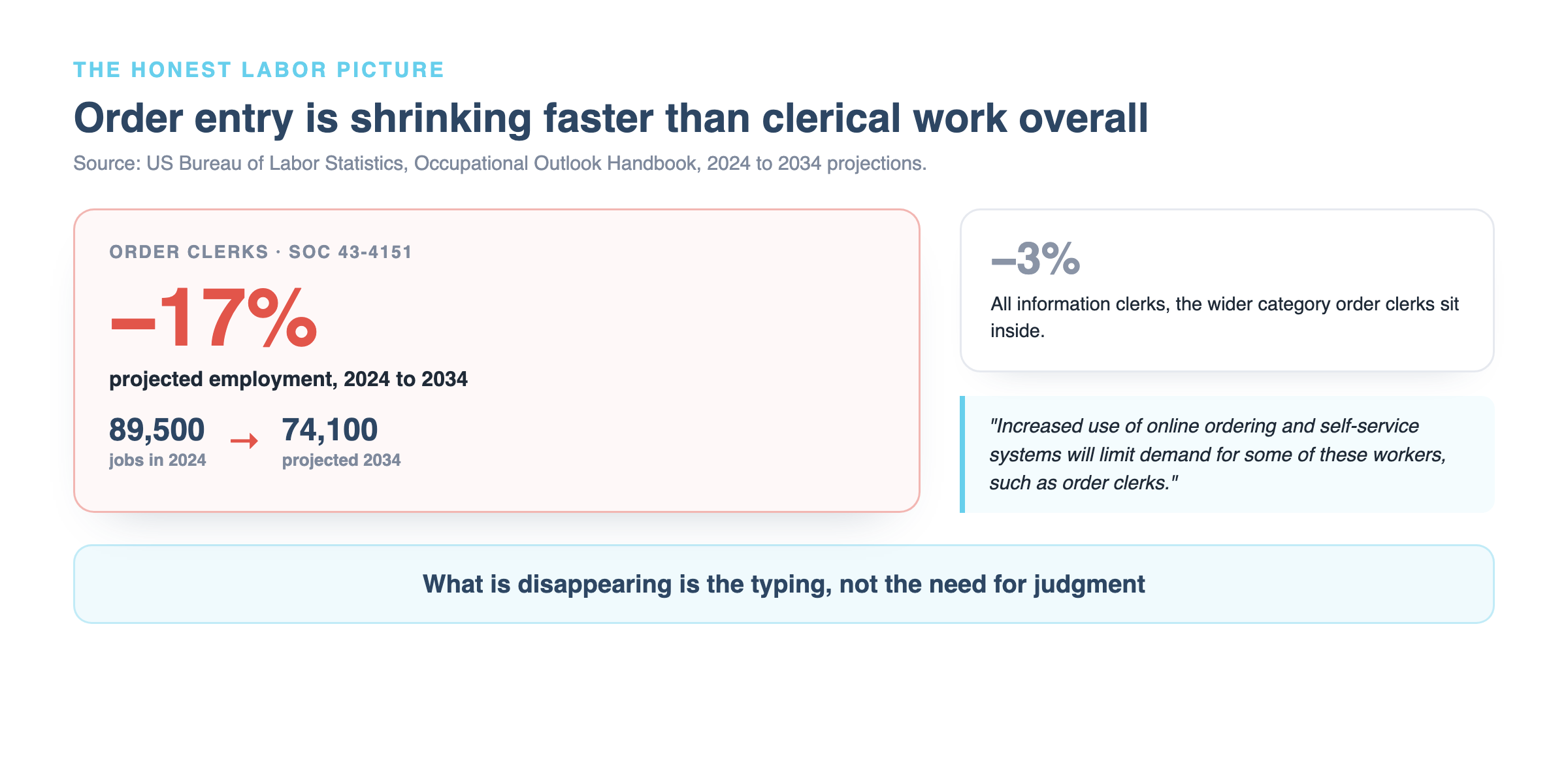
The Bureau of Labor Statistics is blunt about the direction, and the number for this specific job is sharper than most people expect. BLS projects employment of order clerks to fall 17 percent from 2024 to 2034, from about 89,500 positions to 74,100. It also names the cause outright, noting that increased use of online ordering and self-service systems will limit demand for these workers. For scale, the wider information clerk category that order clerks sit inside is projected to decline only 3 percent over the same decade, so order entry is shrinking roughly five times faster than clerical work in general.
That is worth sitting with rather than talking around. The transcription job really is going away over the next ten years, and no amount of reassurance changes the projection. What the projection does not describe is a layoff event at any single branch. It is a national figure spread across a decade, and it mostly reflects seats that quietly stop being refilled rather than people walked out. So the useful question for an operator is not whether to protect the typing. It is what the person doing it moves on to before the typing disappears on its own.
What the order entry job becomes
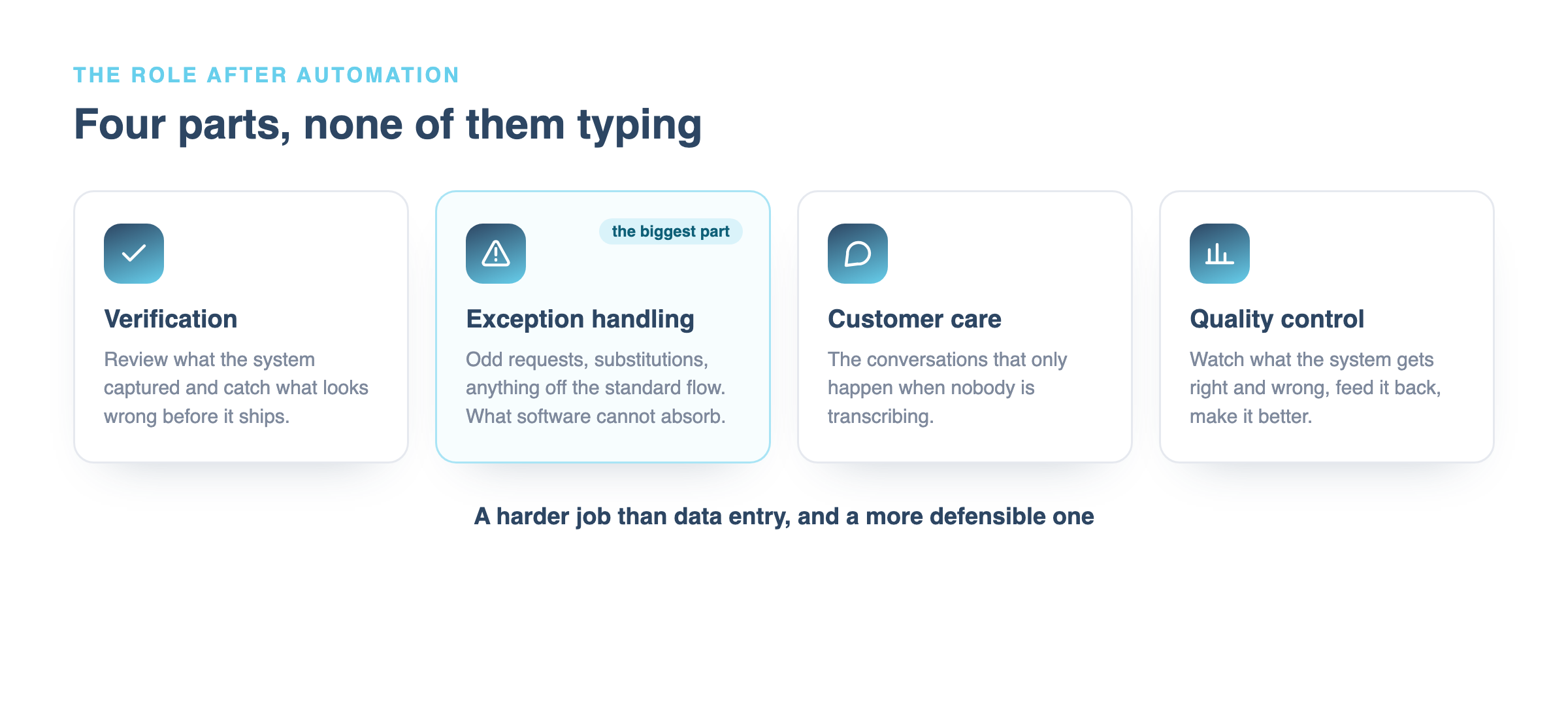
The role that emerges has four parts, and none of them are typing. The first is verification: reviewing orders the system captured automatically and catching the ones that look wrong before they ship. The second is exception handling, which is where most of the real work moves. The odd request, the substitution, the customer who wants something that does not fit the standard flow, all of that still needs a person, and it is precisely what automation cannot absorb. The third is customer care and upselling, the conversations that only happen when someone is not busy transcribing. The fourth is quality control, watching the pattern of what the system gets right and wrong and feeding that back so it improves.
Put together, that is a harder job than data entry and a more valuable one. It is also more defensible, because it is built from exactly the things that do not automate.
From typist to customer relationship manager
The emotional shift matters as much as the functional one. A clerk who spends the day repeating what a contractor said into a screen is a typist, whatever the job title says. The same person, freed from that, becomes the one who knows that this customer always orders short before a big job, that this account has been quietly buying less for two months, that this substitution will cause a problem on site. That is relationship management, and it is the part of a distribution business that competitors cannot copy from a price list.
Most operators already know which of their people are good at this. They are usually the ones on the phone who customers ask for by name, and they are usually the ones with the least time to do it, because they are buried in order entry. The wider version of this dynamic, why good operations people resent the systems they use, is one we covered in why your best operations people quietly hate your software.
Same team, more volume
For a distributor, this is where the economics land. If the clerks you have are spending most of their day on manual entry, and phone orders still carry the bulk of the volume, as we covered in why most food distribution orders still come in by phone, then their capacity is capped by typing speed. Take the typing out and the same team can carry noticeably more order volume without a single new hire. Given how hard those seats are to fill and how long a new clerk takes to become useful, capacity per person is usually a more reliable lever than recruiting.
The transition itself is not dramatic. The automation and the existing manual process run side by side for a few weeks, the team compares results and flags what the system misses, and nothing depends on it until it has earned that trust. We wrote about that rollout pattern and the trust it requires in does automating a task replace the person or just the busywork, and we build this kind of process automation on the systems a company already runs, as in our process automation case.
Frequently asked questions
Does automating order entry mean laying off the order entry clerk?
Usually not in a distribution branch, because the constraint is workload rather than headcount, and the freed time goes to exceptions, customer care, and quality control. The honest caveat is that the pure data entry version of the role is declining nationally. BLS projects order clerk employment to fall 17 percent from 2024 to 2034, from about 89,500 positions to 74,100, citing online ordering and self-service systems. Within a branch that usually plays out as seats not being refilled, not people being let go, but the direction is real.
What does an order entry clerk do after phone orders are digitized?
Four things: verifying orders the system captured automatically, handling exceptions and non-standard requests, customer care and upselling, and quality control on what the automation gets right or wrong. Exception handling usually becomes the biggest part, since unusual requests are exactly what software cannot absorb. It is a harder and more valuable role than transcription.
Is the order entry clerk role disappearing?
The transcription part of it is. BLS projects order clerk employment down 17 percent from 2024 to 2034, roughly 89,500 positions falling to 74,100, and points to online ordering and self-service as the reason. That is a faster decline than clerical work overall, which is projected at 3 percent. What it does not mean is that distributors stop needing people on orders. The work that remains is exceptions, judgment, and customer relationships, which is the part automation does not take.
How much more volume can a team handle after automation?
It depends on how much of the day currently goes to manual entry, which is why the honest answer is to measure it before promising a number. The mechanism is simple: when typing is no longer the bottleneck, capacity is set by how fast exceptions and customer conversations can be handled instead. Distributors where phone orders dominate generally have the most room to gain.
How do you move a team onto automated order entry without disruption?
Run it in parallel with the existing manual process for a few weeks so nothing depends on the automation until it has proven itself. The team compares both, flags what the system misses, and the feedback tightens it before the switch. Involving the clerks in that comparison also matters, since they are the ones who know which orders are unusual and why.
See how the role changes, not disappears
Digitizing phone orders is not a headcount decision. It is a decision about what the people already on the payroll spend their day doing, and whether the business can carry more volume without hiring into a market where these seats are hard to fill. The typing is going away either way. The useful question is what the team does with the hours it gives back. 3ALICA builds order entry automation on the systems a distributor already runs, and we start by measuring where the hours actually go.
Sources
- US Bureau of Labor Statistics, Occupational Outlook Handbook: Information Clerks, Job Outlook (order clerks, SOC 43-4151, projected to fall from 89,500 to 74,100 jobs, a 17 percent decline 2024 to 2034; online ordering and self-service systems named as the cause)
- US Bureau of Labor Statistics, Industry and occupational employment projections overview, 2024 to 2034
Digitizing an order path without touching the ERP behind it is the Workflow Automation Sprint.